The Rise of Causal ML: Big Tech's Monopolistic Moat

Amazon has hired over 150 PhD economists in recent years, now second only to the Federal Reserve. They're hiring them to forecast demand, measure localized inflation, and run pricing experiments that integrate causal inference with machine learning. This hiring trend across tech led me to a non-obvious insight: economics and machine learning solve different problems that complement each other.
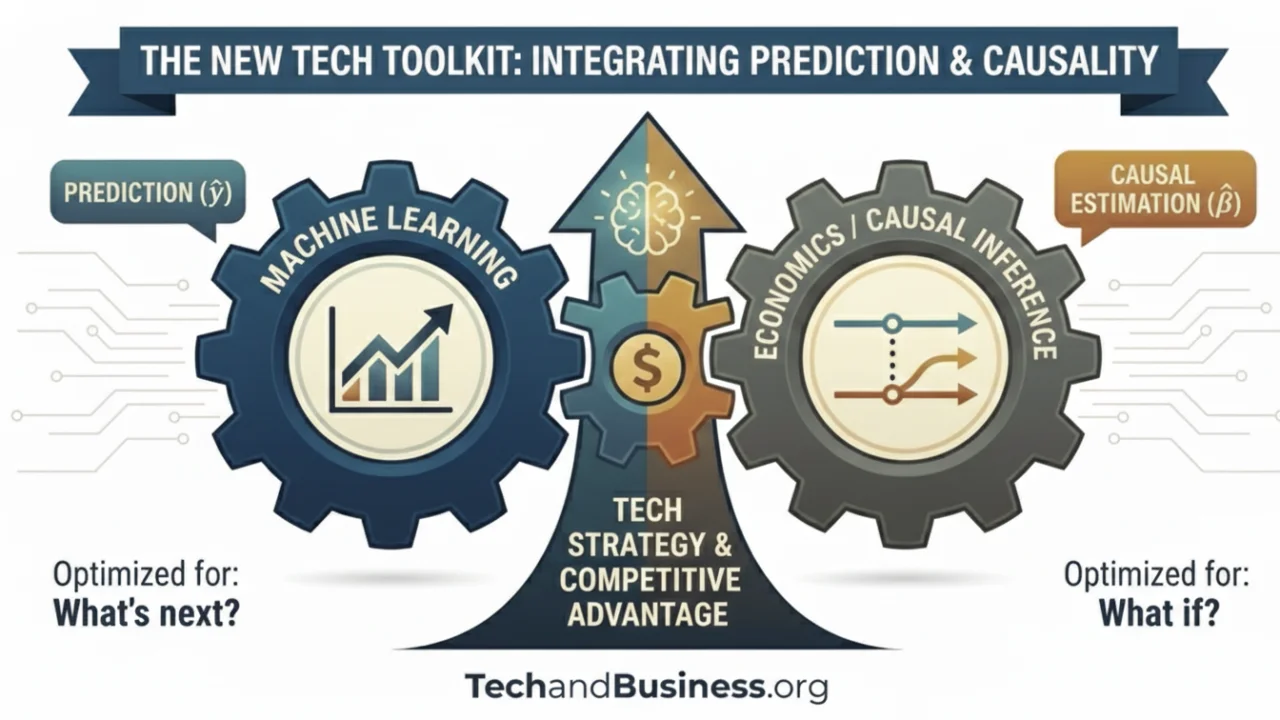
Machine learning and econometrics are complementary tools optimized for fundamentally different problems—prediction (ŷ) vs. causal estimation (β̂). Understanding this distinction is becoming the key differentiator for strategic roles in tech.
Most people see machine learning as 'better statistics with bigger data.' ML algorithms consistently outperform traditional methods in prediction tasks,from facial recognition to forecasting house prices. As Mullainathan and Spiess note in their Journal of Economic Perspectives paper, these algorithms are 'technically easy to use: you can download convenient packages in R or Python.' The danger? 'This also raises the risk that their output is misinterpreted.' If ML is so powerful, why would Amazon pay premium salaries for economists?
The answer lies in what Mullainathan and Spiess formalize: 'Machine learning belongs in the part of the toolbox marked ŷ rather than in the more familiar β̂ compartment.' Machine learning excels at prediction, given customer characteristics X, will they buy product Y? These are ŷ problems. Econometrics excels at causal estimation—what’s the true effect (β) of a 20% discount on wireless headphones? These require fundamentally different approaches.
Here’s the crucial nuance: ML algorithms like LASSO predict beautifully but show radical coefficient instability across samples. The regularization that makes ML powerful for prediction simultaneously makes it inconsistent for parameter estimation, explaining why companies need both. Consider Amazon's pricing infrastructure: they run thousands of experiments to isolate price effects from confounders like seasonality. But they can’t experiment on every product, ML predicts optimal prices for millions of untested products. The causal question (β̂ ): does lowering prices cause higher demand? The predictive question (ŷ): which untested products will respond similarly?
My IO coursework showed how transaction costs and asset specificity drive vertical integration. IBM acquired Red Hat for their open-source Linux expertise, essential for cloud computing. Amazon similarly doubles down in vertically integrating economists (150+ PhDs) and creating the infrastructure by releasing PyWhy, their open-source causal ML toolkit. Just as Red Hat's Linux became foundational for cloud, Amazon is positioning causal ML as foundational for tech strategy. This reshapes market structure—firms integrating both frameworks gain structural advantages. Amazon runs experiments on seller pricing to improve demand predictions. In return, millions are saved as experimental A/B testing becomes vastly less generalizable to broader customer segments in comparison. When this capability vastly enhances surplus extraction, you can’t outsource it. The economist migration isn't just a hiring trend, it's firms recognizing causal inference as a specialized asset requiring vertical integration.
In running techandbusiness.org and covering AI developments, this insight better informs my analysis of the future strategic landscape in the tech industry. The competitive question is 'Which problems require prediction versus causal estimation, and how do they interact to enable more surplus extraction?' Understanding when you need ŷ versus β̂ is becoming the critical skill.
Co-founder of Tech & Business and podcast co-host. Studies Mathematics, Economics, and Computer Science at Amherst College. Covers business strategy and markets.

Comments
Sign in to join the conversation
Loading comments...