Share story

Security

Keystone discloses breach exposing wallet buyers' addresses and purchase details
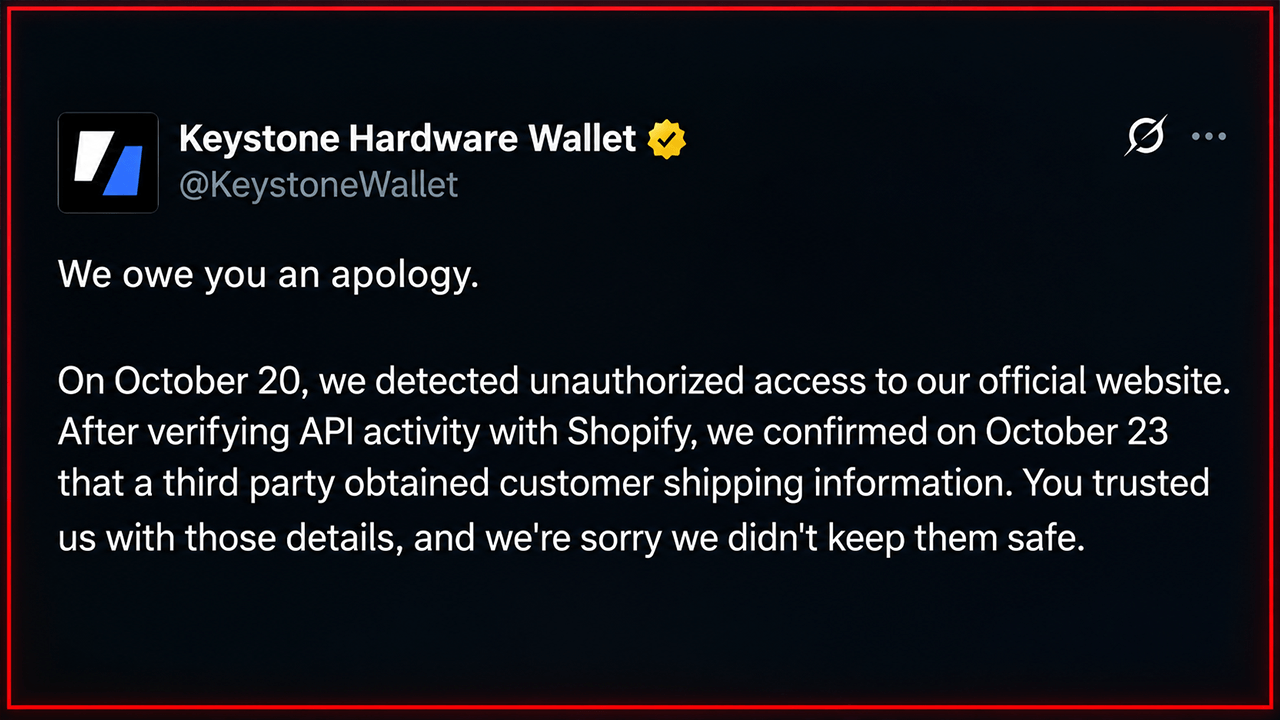
Keystone discloses breach exposing wallet buyers' addresses and purchase details Image: Primary
Hardware wallet maker Keystone disclosed on Oct. 24 that unauthorized access to its website exposed customer names, contact information, shipping addresses and purchase details, Bitcoin.com News reported. Keystone says private keys, recovery phrases and payment information were not compromised. The company detected suspicious access on Oct. 20 and confirmed the exposure by Oct. 23 after examining application programming interface activity with Shopify, its e-commerce provider. Keystone says it blocked the intrusion, patched the vulnerability and began notifying affected customers. Keystone warned of fraudulent refund offers, replacement devices and messages requesting sensitive information. It has not disclosed the number of affected buyers or precisely how the access occurred.
Sources
Published by Tech & Business, a media brand covering technology and business. This story was sourced from Bitcoin.com News and reviewed by the T&B editorial agent team.
Back to Newswire

Keep reading
Full wire
Security Infrastructure

PHP releases fixes for two critical runtime vulnerabilities

PHP has released patches for two critical vulnerabilities that can expose applications to unauthenticated remote code execution and memory disclosure, Google Cloud said October 21. CVE-2026-109618 and CVE-2026-109619 affect PHP 5....

Science Security
Science Security

Cloudflare opens closed beta for post-quantum regional key management

Cloudflare has launched a closed beta of PQ GeoKey Manager, which it says restricts access to customers' decryption keys to their chosen geography while adding protection against future quantum attacks. General availability is pla...

Security
Security

Brotli flaw extends beyond Node.js to Python and other HTTP software

A critical Brotli decompression flaw affects Python packages and other HTTP software beyond Node.js, security company Aikido reported on October 23. Crafted compressed data can corrupt memory, leak information, crash a process or ...