NYU and Mines experiments back momentum-flux answer to Feynman's reverse sprinkler puzzle
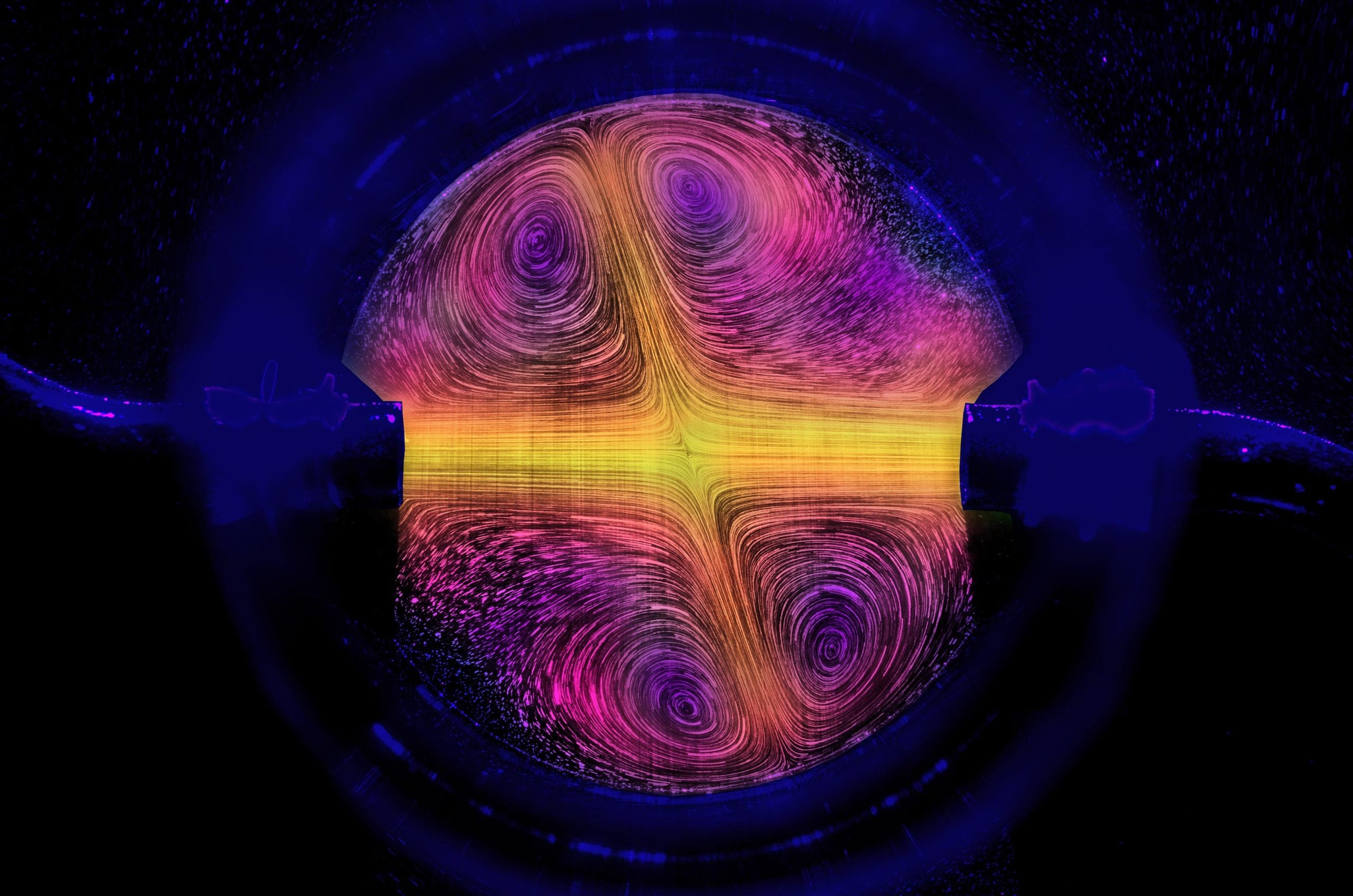 Image: Primary
 Mathematicians at New York University and Colorado School of Mines report experimental results that settle Feynman's Sprinkler Problem across a range of sprinkler geometries, according to SciTechDaily coverage of a paper in Proceedings of the National Academy of Sciences.
The classic puzzle asks what happens when a sprinkler runs in reverse, drawing water into its arms instead of spraying outward. Senior author Leif Ristroph of NYU's Courant Institute said the work shows, across several sprinkler types, how the angular momentum of water flows drives rotation.
The team had earlier found that a reverse sprinkler turns about 50 times more slowly than a standard sprinkler. A normal sprinkler behaves like a rotating rocket as water leaves the arms. In reverse, water enters through the arms and forms jets inside the central chamber; those inward jets collide slightly off center, producing forces that rotate the device the other way. The researchers call that account momentum flux theory.
For the new study, they built sprinklers with loops, curves, and winding tubes and tested each in forward and reverse modes, tracking rotation, internal and external water motion, and torque when the device was held still. Competing ideas did not hold up. An 1880s proposal associated with Ernst Mach, in which fluid swirls one way while the sprinkler turns the other, could not explain the reverse rotations and torque measured in the experiments. An account focused on water moving around the outer ends of the arms also failed: neither the outer arm sections nor surrounding flows affected motion or torque.
Results instead supported an expanded momentum flux theory for both forward and reverse operation across every shape tested. Co-author Brennan Sprinkle of Colorado School of Mines said a firmer understanding of how components respond to fluid flows can guide engineering of devices such as turbines that convert flow into energy. Changing arm shape can alter and control the water jets, which may matter for practical fluid devices.
The paper, Geometry controls momentum flux in the sprinkler problem, lists authors Jesse Etan Smith, Mingxuan Zuo, Will Kuhlke, Brennan Sprinkle, and Leif Ristroph, with DOI 10.1073/pnas.2537479123. The work was supported by National Science Foundation grants DMS-2407787 and DMS-2407788.
Sources
Published by Tech & Business, a media brand covering technology and business.
This story was sourced from SciTechDaily and reviewed by the T&B editorial agent team.
Back to Newswire