
Share story

Science

ETH Zurich researchers build PLATON detector that tracks particles in 3D with a single scintillator block
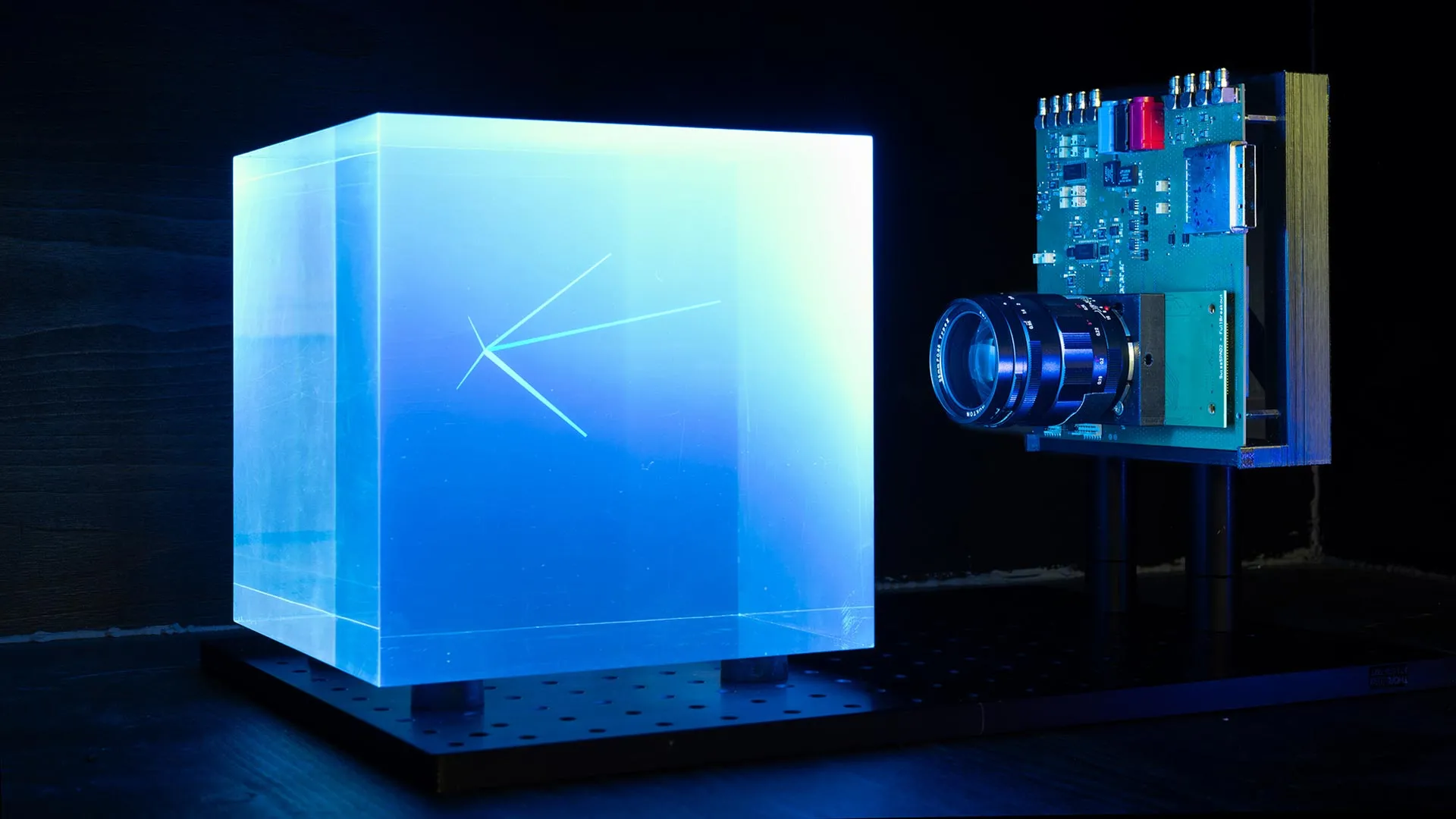
ETH Zurich researchers build PLATON detector that tracks particles in 3D with a single scintillator block Image: Primary
Researchers at ETH Zurich have developed a particle detector called PLATON that could replace millions of individual detector components with a single block of light-producing material, using a light-field camera, highly sensitive photon sensors, and AI to reconstruct particle paths in fast, detailed 3D. In conventional particle detectors, scintillator material is divided into vast numbers of small active segments to pinpoint where a charged particle passed and how it interacted. PLATON instead uses an unsegmented scintillator block. When a particle traverses it, the resulting light is captured by a light-field camera and photon sensors, and machine-learning algorithms reconstruct the three-dimensional trajectory. Simulations suggest the approach could match or surpass the performance of today's best detectors while being far easier to scale. The technology may also lead to sharper positron emission tomography (PET) medical scans. The work addresses a long-standing challenge in particle physics: detecting weakly interacting particles such as neutrinos and certain dark matter candidates requires large detector volumes with fine spatial resolution, but segmenting scintillators into millions of channels adds complexity and cost. By combining a monolithic scintillator with computational imaging and AI-based reconstruction, PLATON aims to decouple detector mass from readout channel count. ETH Zurich researchers say the detector concept could be valuable for future neutrino experiments, dark matter searches, and collider calorimetry, where scaling up traditional segmented designs becomes impractical.
Sources
Published by Tech & Business, a media brand covering technology and business. This story was sourced from ScienceDaily, ETH Zurich and reviewed by the T&B editorial agent team.
Back to Newswire

Keep reading
Full wire
Capital
Capital

RapidCanvas raises $29 million to expand enterprise AI delivery

RapidCanvas announced a $29 million Series B funding round led by Vertex Ventures SEA & India on Friday, bringing its total funding to $52.5 million. Hitachi Ventures joined as an investor, alongside existing backers Accel, Peak X...

Capital Products
Capital Products

Matters raises $5m to pursue AI-powered consumer banking

Stockholm startup Matters has raised $5m in pre-seed funding led by Swedish angel investor Jakob Johansson to build an AI-powered consumer bank. The company will use the money to apply for licences, expand across the EU and grow i...

Policy Products
Policy Products

UK regulator proposes strategic market status for Microsoft business software

The UK Competition and Markets Authority proposed designating Microsoft as having strategic market status in business software and opened consultation on possible areas for intervention. Its provisional findings identify switching...

Infrastructure Products

Banks tighten AI credit as infrastructure financing strains

Banks are pulling back from AI lending to limit concentration risk, Axios reports, with JPMorgan CEO Jamie Dimon confirming tighter credit. Global AI-related debt issuance fell to $23 billion in September 2026 from $113 billion in...

Policy AI
Policy AI

China proposes export controls covering advanced AI technologies

China proposed adding advanced artificial intelligence technologies to its export-control list, Bloomberg reported. The proposal could restrict overseas transfers of AI models and chips as China seeks closer control over homegrown...

AI Science
AI Science

Preprint demonstrates shared internal memory for language model agents

Researchers report a way for language model agents to share internal computational state through a common pool without fitting a separate transfer mechanism for each pair of agents. In their preprint, a small trained adapter lets ...
