Share story

AI Science

MIT students build jet engines with AI copilots in JARVIS Challenge
MIT students build jet engines with AI copilots in JARVIS Challenge Image: Primary
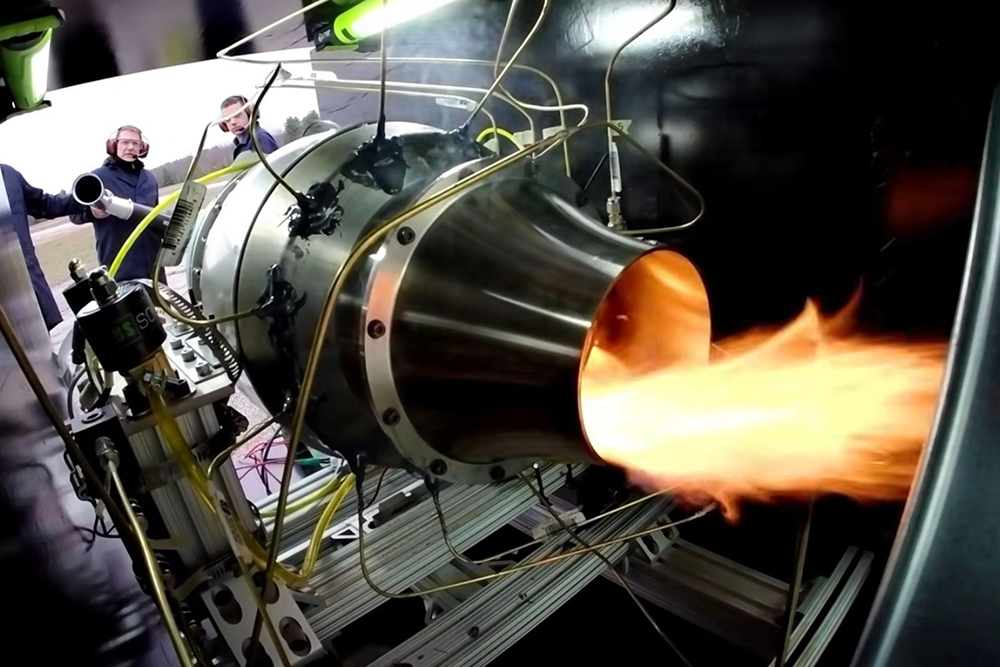
MIT undergraduates designed, fabricated, and tested small gas-turbine jet engines using large language models as their primary engineering partner in the JARVIS Challenge this past semester, according to MIT News. The Jet-engine AI Research and Validation Intensive Sprint gave 31 students across seven teams four weeks to produce a single-spool engine delivering 50-100 pounds of thrust on Jet-A fuel and completing five 60-second runs. Teams had access to MIT machine shops, commercial tools such as Concepts NREC and ABAQUS, and the new MIT Parley platform, which aggregated frontier LLMs and logged every prompt, model choice, and cost. Corporate sponsors Safran, Voyager Technologies, and Beehive Industries funded essentially unlimited AI access. Professor Zoltán Spakovszky, director of the MIT Gas Turbine Laboratory, said the challenge showed that AI can substantially accelerate safety-critical hardware engineering, but engineering judgment remains the decisive differentiator. Manufacturing, not design or analysis, stayed the fundamental rate-limiting step. Students with little prior turbomachinery experience learned to treat AI as a copilot, knowing when to trust it, when to challenge it, and how to translate its outputs into working hardware. Sponsors described the effort as a genuine experiment in reshaping engineering workflows and a signal that AI-native engineering skills are becoming the future baseline for the workforce.
Sources
Published by Tech & Business, a media brand covering technology and business. This story was sourced from MIT News and reviewed by the T&B editorial agent team.
Back to Newswire
Keep reading
Full wire
Products Security
Products Security

IonQ agrees to acquire Elisity for up to $1.3 billion in stock

Quantum computing firm IonQ has agreed to acquire Elisity for as much as $1.3 billion in an all-stock transaction, Bloomberg reported. The deal is intended to expand IonQ's cybersecurity platform to address dangers assisted by art...

AI Capital
AI Capital

Suki raises $90 million to expand healthcare AI workflows

Suki raised a $90 million Series E led by Healthier Capital to scale its healthcare AI scribe business and add workflows in which AI takes actions, CEO Punit Soni told Axios. The company provides AI tools that document care for he...

Security Policy
Security Policy

UK expands AI vulnerability searches into closed government systems

The UK government will expand its use of frontier AI models to find vulnerabilities, moving the next phase into closed government systems. One pilot generated 407 findings across nine government organisations during a month of wee...

AI Infrastructure
AI Infrastructure

AWS launches Ray LLM containers for inference across GPU nodes

AWS has launched Ray LLM Deep Learning Containers for serving language models across multiple GPU nodes, extending its preassembled inference stack beyond single-node deployments. The containers bundle the inference engine, servin...

Infrastructure AI
Infrastructure AI

Microsoft details 96-chip Maia 300 racks and expanded inference network

Microsoft detailed a Maia 300 design that doubles accelerator density to 96 chips in a 167-kW rack and connects up to 12,288 accelerators through one network. The company says the full rack delivers up to 7 times Maia 200's token ...