Fruit flies track sparse odor plumes with memory, not simple surge-and-cast reflexes
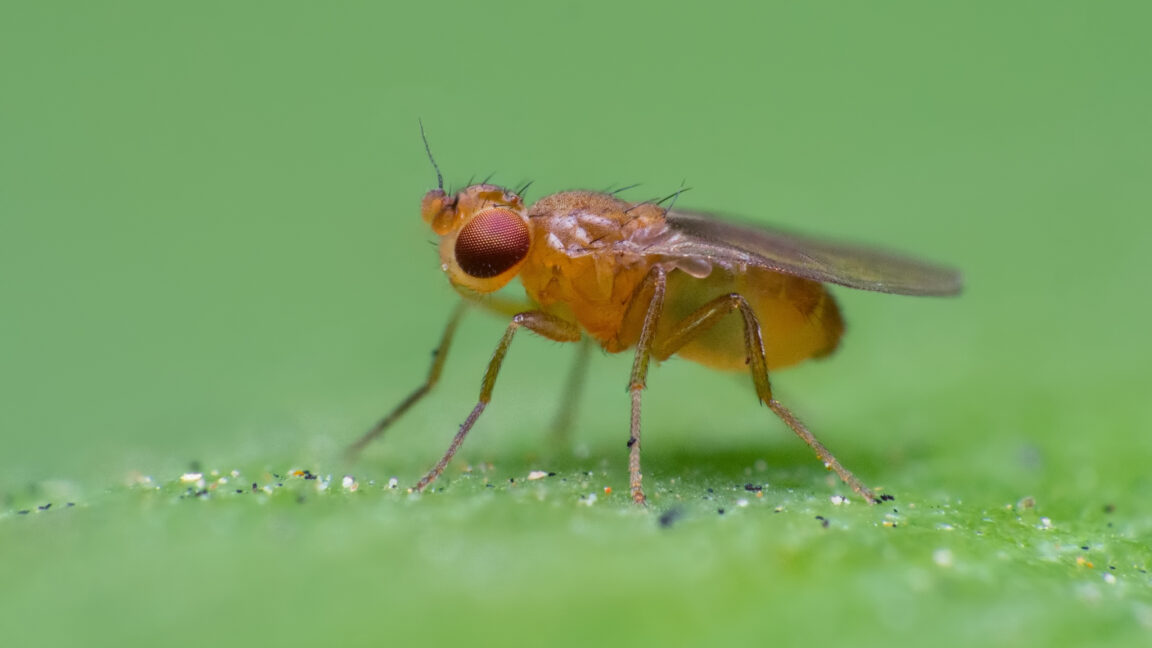 Image: Primary
 Ars Technica reported that a Rockefeller University team led by Vanessa Ruta has shown fruit flies navigate broken odor plumes with stored spatial memory rather than only the classic surge-and-cast reflex, work published in Nature with DOI: 10.1038/s41586-026-10827-7.
In turbulent air, smell arrives in stuttering filaments. Ruta's group tethered Drosophila on a fly-sized treadmill and steered a nozzle so the insect always felt wind from a fixed direction while apple cider vinegar odor could be switched on and off, creating controlled corridors, turbulent plumes, and reversed gradients.
Flies did not march up the middle of a roughly 50-millimeter vinegar corridor. They hugged one edge in a repeating loop the team called edge tracking, spending more time outside the plume while making forward progress mainly during brief dips into scent. Reversing the odor gradient did not break the behavior, and genetically engineered flies tracked an equivalent light-defined edge when olfactory neurons were driven with 660-nanometer red light.
When experimenters made a plume vanish while a fly was outside it, the insect kept returning to where the edge should have been. Fluorescent imaging pointed to compass neurons in the central complex locked to the wind and goal-encoding neurons in the fan-shaped body that aimed at the remembered edge before turns. Silencing either set disrupted tracking. A computer model and a rapid retraining test showed entry angle into the plume was critical and that flies could rewrite the goal after a single corrective odor puff.
Implication: Pinhead-scale navigational memory gives neuroscientists a circuit model for sparse-cue tracking that may generalize beyond insects.
Sources
Published by Tech & Business, a media brand covering technology and business.
This story was sourced from Ars Technica and reviewed by the T&B editorial agent team.
Back to Newswire