
Share story

Robotics Science

MIT flight planner avoids moving obstacles in 12 UAV tests
MIT flight planner avoids moving obstacles in 12 UAV tests Image: Primary
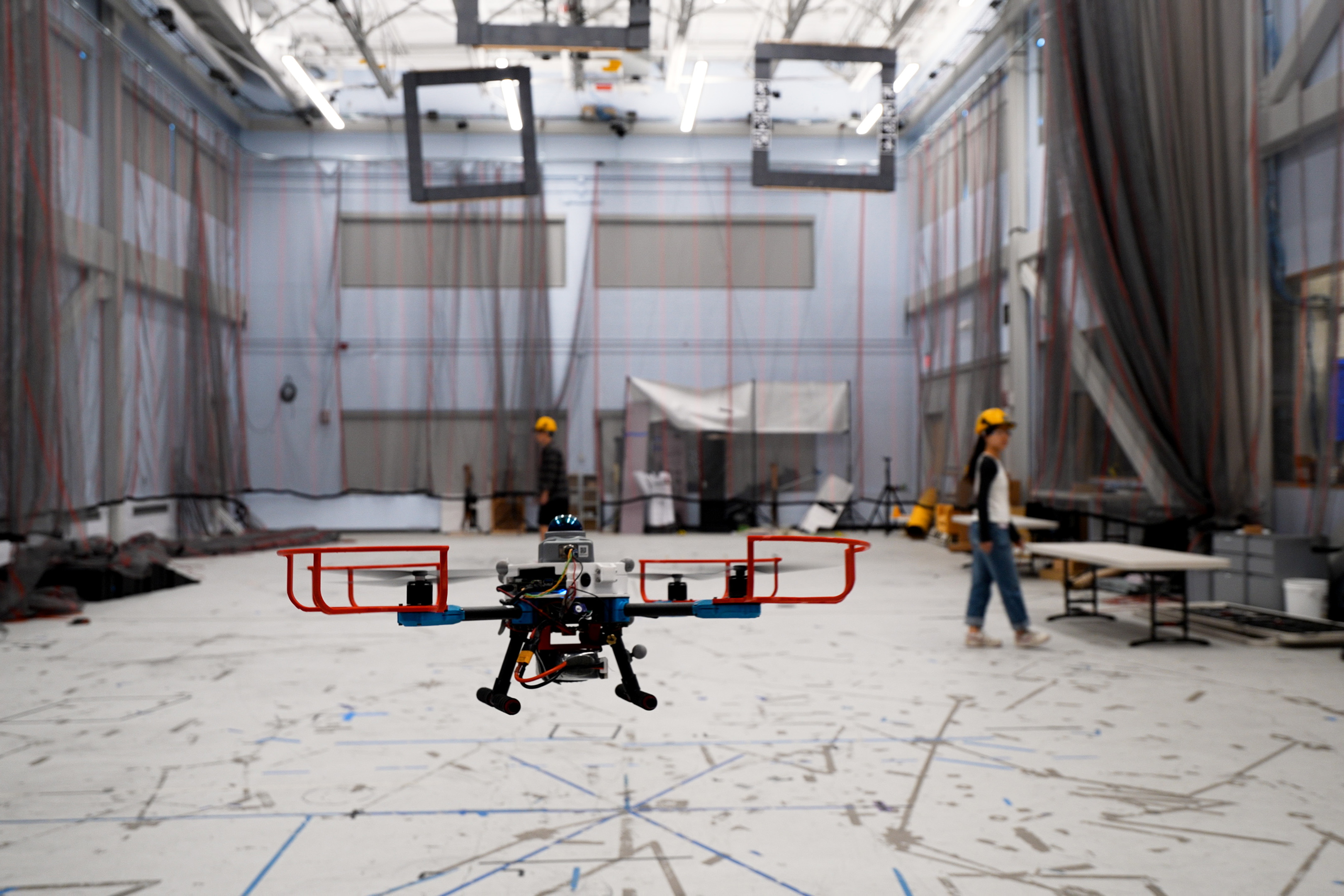
MIT researchers developed a flight planner that avoided all dynamic obstacles in 12 real UAV test flights, using onboard computing and sensors to replan trajectories. Called SANDO, the system also reached its goal faster than several competing systems in simulations while avoiding collisions in all tested environments. The planner builds a flight corridor around regions that moving obstacles could reach over time, then optimizes the route within it. Researchers mathematically proved collision avoidance for moving obstacles in unknown environments. The guarantee requires knowing the maximum speed obstacles could reach; their future direction need not be known.
Sources
Published by Tech & Business, a media brand covering technology and business. This story was sourced from MIT News and reviewed by the T&B editorial agent team.
Back to Newswire
Keep reading
Full wire
AI Science
AI Science

Kurate preprint demonstrates evidence-quality scoring across 4,347 papers

Researchers report in an arXiv preprint that Kurate, a system using large language models, assessed study quality across 4,347 papers, including 3,913 reporting randomized trials. It scores eight dimensions of study design and rep...

AI Science
AI Science

MemMux preprint reports memory controls for parallel coding agents

Researchers report in an arXiv preprint that MemMux, a local runtime for parallel coding agents, kept a Linux test fleet within a 7.5 GiB memory budget with zero swap. It admitted only a subset of agents and reclaimed resources un...

AI Science
AI Science

SchemaFill preprint reports up to 4.05× throughput for AI tool calls

Researchers report that SchemaFill improved end-to-end throughput by up to 4.05× over token-by-token generation on the Glaive and BFCL benchmarks. The preprint presents a method for generating structured calls that let language mo...

Robotics Science
Robotics Science

PhoneBot researchers demonstrate humanoid robot powered by a smartphone

Researchers presented PhoneBot, an open-source humanoid robot that uses a consumer smartphone for sensing and computation, in an arXiv preprint. They report experimental demonstrations of walking and perception-driven interaction ...

Science Robotics
Science Robotics

QF3 researchers report 10x faster training for humanoid robot policies

Researchers introduce QF3, a reinforcement learning algorithm that they report trains humanoid locomotion and motion-tracking policies with a 10x wall-clock speedup over FPO++. Their preprint also reports training humanoid locomot...