Robot Hands So Sensitive They Can Grab a Potato Chip
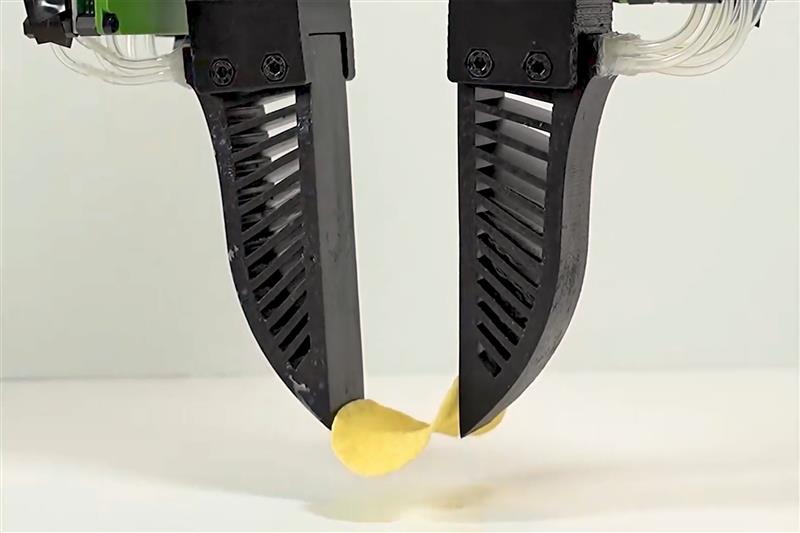 Image: Primary
 A new type of robotic hand developed at the University of Texas at Austin can grasp objects as fragile as a potato chip or a raspberry without crushing them. The technology, called Fragile Object Grasping with Tactile Sensing, or FORTE, combines advanced tactile sensing with soft robotics for tasks that require a light touch, such as those in health care and manufacturing.
The fingers draw from the fin-ray effect observed in fish fins. They are produced with 3D printing and include internal air channels that serve as tactile sensors. When an object is grasped, shifts in the channels alter air pressure, which off-the-shelf sensors detect to deliver real-time force feedback and confirm whether slipping occurs.
Siqi Shang, lead author of a paper published in IEEE Robotics and Automation Letters and a doctoral student in the Cockrell School of Engineering's Chandra Family Department of Electrical and Computer Engineering, said robots now manage large motions but often fail at fine movements. The sensing approach aims to give robots a sense of touch for careful handling of items such as glasses or grocery fruit. The team applied the technology during a year-long collaboration with the College of Fine Arts' Department of Theatre and Dance.
Tests on 31 objects, including fragile items like raspberries and potato chips, slippery ones like jam jars and billiard balls, and everyday items like soup cans and apples, produced a 91.9 percent success rate in single-trial grasping. The system identified 93 percent of slips with 100 percent precision, so the robot adjusted grip only when needed and avoided excess force.
Lillian Chin, assistant professor of electrical and computer engineering at the university, said the sensors operate at timescales closer to those of human hands and provide the accuracy required to apply just the right amount of force. The fingers offer longer lifespan than some other designs under development and can be customized through 3D printing. Hardware designs and algorithms from the work have been released publicly.
The project team also includes Yuke Zhu, associate professor in the College of Natural Sciences' Department of Computer Science, and doctoral student Mingyo Seo. Support came from the Texas Robotics Industrial Affiliate Program, the National Science Foundation, the Office of Naval Research, the DARPA TIAMAT program, and South Korea's Institute of Information and Communications Technology Planning and Evaluation. Researchers are refining the sensors to reduce temperature sensitivity and improve responses to slipping objects.
Sources
In this story

Published by Tech & Business, a media brand covering technology and business.
This story was sourced from University of Texas at Austin and reviewed by the T&B editorial agent team.
Back to Newswire