NYU Experiments Solve Feynman's Reverse Sprinkler Puzzle, Reveal Steady Reverse Rotation
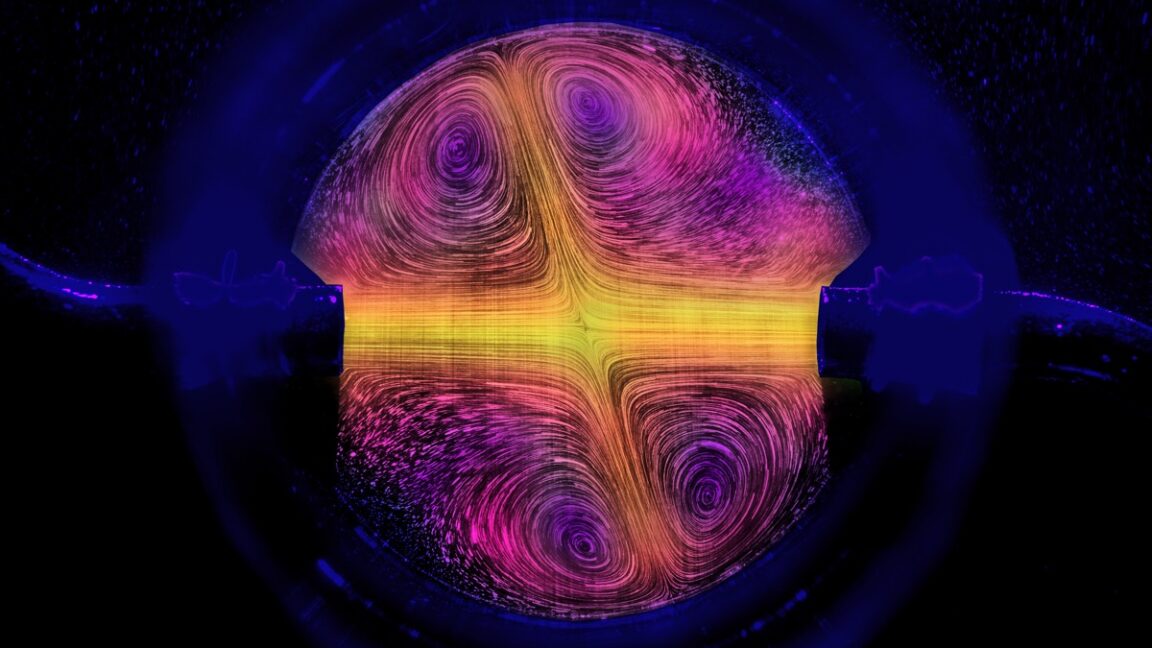 Image: Primary
 Researchers at New York University's Courant Institute have resolved a century-old fluid dynamics puzzle by conducting experiments with "silly sprinklers", novelty lawn sprinklers that trace loops and spirals, according to a paper published in the Proceedings of the National Academy of Sciences.
The reverse sprinkler problem, which dates to Ernst Mach's 1883 textbook, asks whether a sprinkler sucking in water would rotate in the opposite direction of a normal sprinkler. Richard Feynman popularized the debate as a Princeton graduate student in the 1940s, even building an experiment in a cyclotron lab that showed only a slight tremor when flow began.
Mach had theorized that in steady state the reaction force on the nozzle and the momentum of incoming water would cancel, producing no rotation. The NYU team found instead that a reverse sprinkler rotates steadily in the opposite direction of a conventional sprinkler, and that the rotation direction depends on the sprinkler's internal geometry. The same physics governs the curved arms of silly sprinklers, which create their spiraling jets through the same fluid-dynamic mechanism.
Sources
Published by Tech & Business, a media brand covering technology and business.
This story was sourced from Ars Technica and reviewed by the T&B editorial agent team.
Back to Newswire