Share story

Science AI

KAFlow preprint reports more accurate learning of physical dynamics

Researchers report in an arXiv preprint that KAFlow, a neural network method for learning physical dynamics, lowers loss on data outside its training distribution by 3.4 to 11 times on synthetic benchmarks compared with the Kolmogorov-Arnold neural operator. It also recovers every coefficient to within 10^-4 without symbolic templates. KAFlow represents the mathematical rule governing the dynamics through a small set of single-variable functions and automatically extracts a closed-form expression. On long-horizon quantum dynamics, it reduces state infidelity by up to 6 orders of magnitude, with a 30 times reduction when trained only on position and momentum measurements. These findings come from benchmark tests.
Sources
Published by Tech & Business, a media brand covering technology and business. This story was sourced from cs.LG updates on arXiv.org and reviewed by the T&B editorial agent team.
Back to Newswire
Keep reading
Full wire
AI Products
AI Products

Tencent plans about $5 billion bond offering to help fund AI spending

Tencent told fixed-income investors Monday that a planned bond offering of about $5 billion would help finance AI-related capital expenditures, Bloomberg reported, citing people familiar with the matter. The offering would provide...

Security
Security

CloudConnect CRM flaw reportedly allows data theft without a login

Attackers are exploiting a CloudConnect vulnerability to remotely access and steal customer data and internal business records without logging in, The Tech Edvocate reported. The flaw in the cloud platform, which businesses use to...

Robotics
Robotics

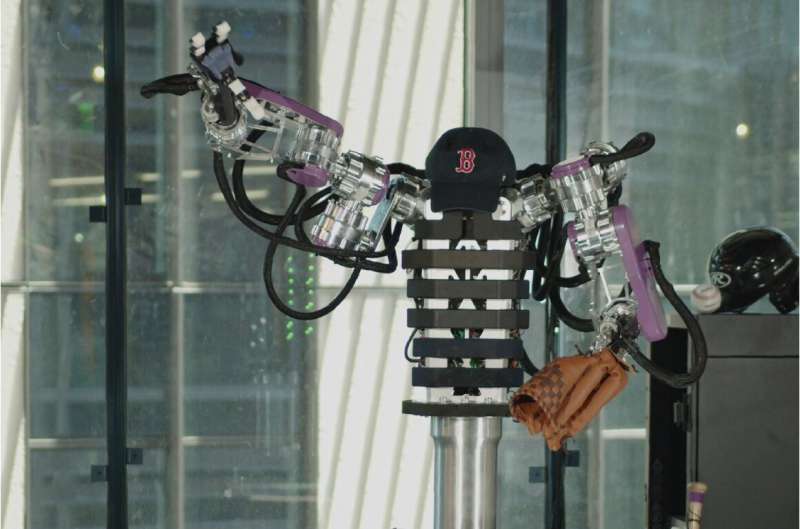
AthenaZero robot demonstrates throwing, catching and batting in tests

Researchers at the Robotics and AI Institute in Cambridge, Massachusetts, have demonstrated a dual-arm robot throwing, catching and batting balls, Electronics For You reported. Called AthenaZero, the system combines low-inertia ar...

AI Science
AI Science

AutoIndexer preprint demonstrates a model that edits its earlier output

Researchers report that AutoIndexer can insert, replace and delete text it has already generated, addressing a limitation of models that produce text in a fixed sequence. Their preprint says the method demonstrates editing after g...