Share story

AI Science

WorldParticle demonstrates one AI architecture for six physical simulation tasks
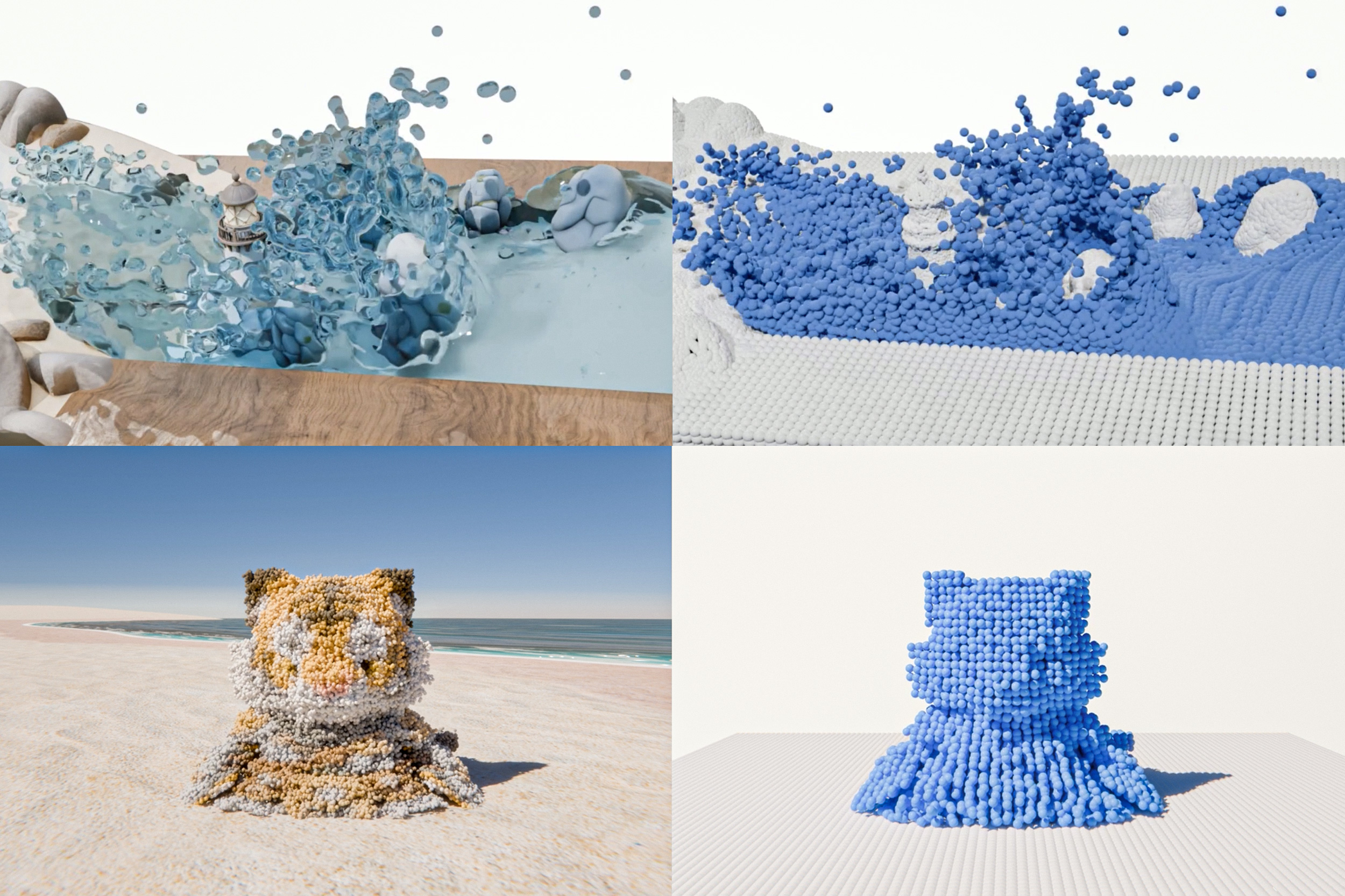
WorldParticle demonstrates one AI architecture for six physical simulation tasks Image: Primary
Researchers at MIT, the University of British Columbia and other institutions demonstrated an AI architecture that modeled six physical phenomena, including deformable objects, granular materials and proteins. MIT says WorldParticle achieved higher accuracy than numerical simulation methods; researcher Minghao Guo says it modeled changes in protein structures about 100 times faster than numerical simulators. WorldParticle represents materials as particles and predicts their next positions and properties. It separates external forces before each prediction and incorporates them afterward, allowing it to handle unfamiliar materials and conditions. A particle-merging technique reduces computation while retaining fine detail. The researchers plan further work toward a full general-purpose simulation pipeline.
Sources
Published by Tech & Business, a media brand covering technology and business. This story was sourced from MIT News - Artificial intelligence and reviewed by the T&B editorial agent team.
Back to Newswire
Keep reading
Full wire
AI Science
AI Science

Samsung reports faster chip simulations using AI and Nvidia GPUs

Samsung achieved a roughly 1,600x speedup in one chip engineering simulation by combining AI-predicted material properties, coarser computational grids and Nvidia GPU acceleration, Nvidia said.

AI Security
AI Security

AIM Intelligence integrates Starfort with Nvidia's agent security runtime

AIM Intelligence is integrating its Starfort agent control platform with Nvidia OpenShell to combine detection of malicious instructions and data leakage with runtime access controls, Nvidia announced. The integration targets employee productivity and enterprise workflows.

AI Infrastructure
AI Infrastructure

Rebellions plans Nvidia-linked AI systems for SK Telecom deployment in 2028

Rebellions plans to connect its R200 AI processors through Nvidia's NVLink Fusion networking platform, with SK Telecom planning to deploy the resulting systems in its AI data center, Nvidia announced. Korea's Ministry of Science and ICT supports the collaboration.