MIT researchers 3D-print concrete bridge with printer-aware topology optimization
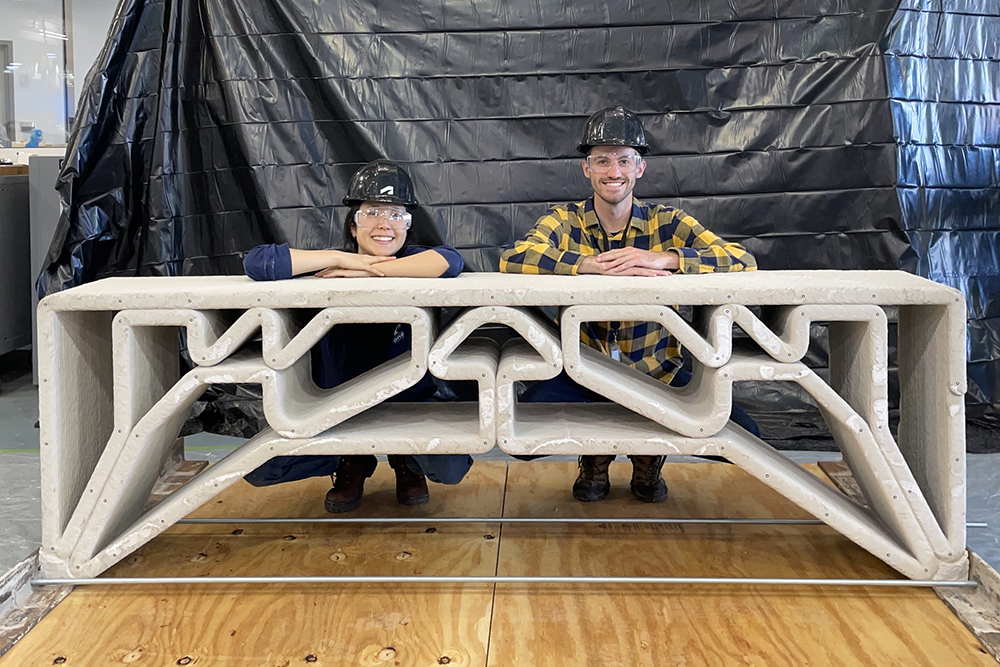 Image: Primary
 MIT researchers have developed a computational framework that bakes the physical limitations of large-scale concrete 3D printers directly into topology optimization, producing designs that machines can build without manual redesign. The work, published in Additive Manufacturing, addresses a longstanding gap: mathematically optimal, spider-web-like structures generated by topology optimization often cannot be printed because they ignore nozzle thickness, turning radius, and the need for continuous print paths.
The team demonstrated the framework by designing, printing, and load-testing a 2.3-meter concrete bridge. Co-first author Hajin Kim-Tackowiak, a postdoc in MIT's Department of Civil and Environmental Engineering, said earlier attempts to translate super-optimal designs into manufacturable ones revealed "cracks you can fall through" between digital design and physical fabrication.
The researchers encoded three printer constraints, minimum bead thickness, maximum nozzle turning angle, and continuous deposition, as mathematical conditions within the optimization itself. The resulting bridge used less material than a conventionally printed equivalent while remaining buildable on existing hardware. Testing showed that current printer hardware, not the concrete material, is the limiting factor for how lightweight a 3D-printed concrete structure can be.
Concrete production is one of the largest single sources of carbon emissions globally. 3D printing eliminates formwork and deposits material only where structurally necessary, but realizing that efficiency gain has required designs that respect what printers can actually do.
Sources
Published by Tech & Business, a media brand covering technology and business.
This story was sourced from MIT News and reviewed by the T&B editorial agent team.
Back to Newswire