NTU and Waseda University give cyborg cockroaches an underwater breathing system
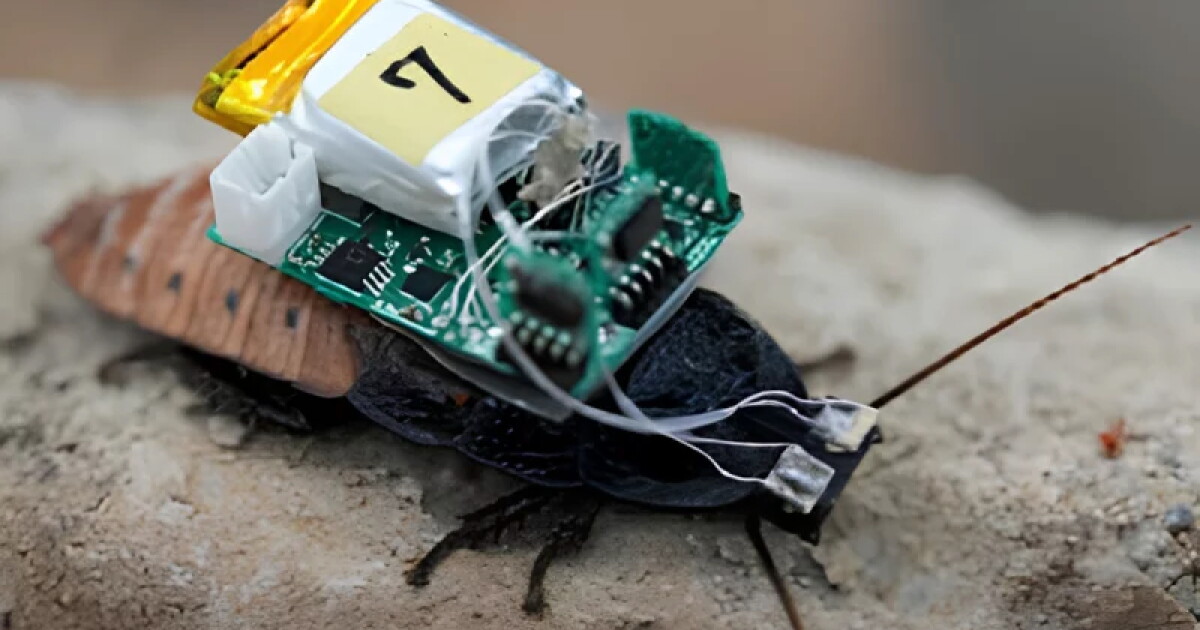 Image: Primary
 Researchers from Nanyang Technological University (NTU) Singapore and Waseda University in Japan have developed a soft, flexible diving suit that lets cyborg cockroaches survive underwater for up to three hours. The suit uses a miniature on-board oxygen generator rather than a pressurized tank, enabling the biohybrid robots to operate in flooded tunnels, low-oxygen environments, and submerged disaster zones.
Cyborg cockroaches are created by mounting a lightweight electronic "backpack" containing a microcontroller, radio receiver, and power source on a living Madagascar hissing cockroach. Steering is achieved by delivering low-voltage electrical pulses to the insect's antennae, hijacking its natural obstacle-avoidance reflex. Other groups, including a University of Osaka team, have demonstrated steering via tiny UV-light helmets that stimulate the insect's alternate eyes.
The new diving suit replaces the rigid backpack with a waterproof, flexible shell that conforms to the cockroach's body. Its oxygen generator consists of a 3D-printed chamber containing a manganese dioxide catalyst and a small volume of dilute hydrogen peroxide. When the catalyst decomposes the peroxide, it produces oxygen gas that travels through four silicone tubes into the insect's thoracic spiracles, its breathing holes, bypassing the surrounding water. The entire assembly weighs little enough that the cockroach's natural gait is preserved.
In lab tests simulating flooded tunnels, the suited insects remained active underwater for up to three hours. Professor Hirotaka Sato of NTU's School of Mechanical and Aerospace Engineering, who led the project, said the system works like a human diver's oxygen tank but generates oxygen on demand chemically rather than storing it under pressure. The team is now working on improving durability, adapting the suit for other insect species, and integrating additional sensors.
The researchers say the technology could extend cyborg insect deployments, already used in real search-and-rescue operations such as the Myanmar earthquake response, to water-related scenarios including flooded rubble, drain inspections, and infrastructure monitoring. The study was published in Nature Communications. Animal handling followed institutional guidelines with no reported harm to the insects.
Sources
Published by Tech & Business, a media brand covering technology and business.
This story was sourced from New Atlas and reviewed by the T&B editorial agent team.
Back to Newswire