Business Automations

I want to use my time as effectively as possible; there is nothing I hate more than wasting it, especially when running a business.
The matter of time is critical in running an effective business; genuinely, every minute counts when making a sale, demonstrating a product to a customer, or pitching your idea to someone else. In business, you are constantly on borrowed time, and you then learn how to make the most of it, whether by making your content more concise and engaging, shortening your sales cycle, or finding the most effective way to transfer information precisely.
Many of these methods exist, yet I’ve found that my best solutions are those that don’t require human input, building effective systems & automations to effectively proceed with business goals.
When managing a CRM or ERP, you for a tool that fits your needs. It could involve using HubSpot, Salesforce, or Pipedrive software to manage your customer relationships, or manually tracking what customers have purchased. This approach will vary by industry. I have found great usage of these tools, especially Pipedrive, to have a simple visualization of where my customers are during the sales process, and for an inexperienced reader, this means I can tell whether a lead is prospective, whether I’ve booked a call or followed up with them, and even if I’ve sent an invoice, and they have paid.
Business processes don’t require much more beyond the standard usage of tools; however, I’ve realized and taken part in the trend of automation, utilizing tools such as n8n, Make, Zapier, or integrated software to optimize these business processes. Automation, at its simplest, is performing tasks without human input, but in such a human field as business, how could it possibly be automated?
Well, here’s what I’ve found: the process begins with a mapping & outline of your business operations
This is an outline of an automated customer journey. Note the branching pathways & customer segmentation that is being performed. The automation includes a basic lead form that allows customers to qualify and locate themselves on their own path. This is the automation for a full client sales cycle being sold business-to-business, which means customers are in different industries, such as e-commerce or agencies themselves. The automation identifies who they are through customer segmentation and begins to personalize; this is where the magic happens. Normally, the very nature of personalization requires human interaction; however, this automation leverages AI (my favorite buzzword) to understand who the client is and their needs based on the form they filled out, and then uses this information to curate & create specific content paths for the prospective customer. This means that through automation, a customer is given bespoke & relevant case studies, landing pages, and sales materials to guide them throughout the process.
On the operations side, I’m sure you can imagine that this becomes more than handy. We’ve just transformed our basic sales cycle into an intelligent revenue-generating machine, and we have properly qualified & educated our customers before even making contact with them. As a result, they are being served personalized content. Automations such as these have a direct correlation with higher close rates in the sales cycle, and, of course, this is because the customer feels that you have held their hand throughout the entire process.
What I find interesting still is that this automation includes SOPs for clients who are unqualified, as they may eventually become qualified. It will nurture them through relevant emails and touch base with them automatically. Even if someone no-shows the call, it will follow up with them, acknowledging that they have no-showed. This call automation also includes a dashboard for intelligent business analytics, which showcases statistics throughout the process.
In my own pursuits, I closely modeled this automation. I spoke to the person who sells this, and it costs business owners $9,250, a fairly high price for such a useful tool. I wasn’t able to shell out my own cash, and I thought to myself, this could be quite useful to learn. I took it upon myself to research and learn how business processes are actually automated, as well as the tools that go into them.
I first learned Make through one of my mentors, and I automated the process of enriching my leads with relevant information, a basic tool that helped me figure out how exactly I should speak to my client through who they were. I then learned N8N, a technical monster of a tool.
N8N integrates with most business software and is extremely flexible. I’m not sponsored by them, so I’ll stop glazing them, but it speaks volumes to how useful this tool really is.
Attached is a sample N8N workflow. To give a visual example of how these flows really work, you can see it begins with an HTTP request, which is then sent to Airtable (a cloud relational database platform) and is capable of parsing through the database with specific instructions. This is a basic workflow for setting matches in Airtable, but these workflows delve quite deeply.
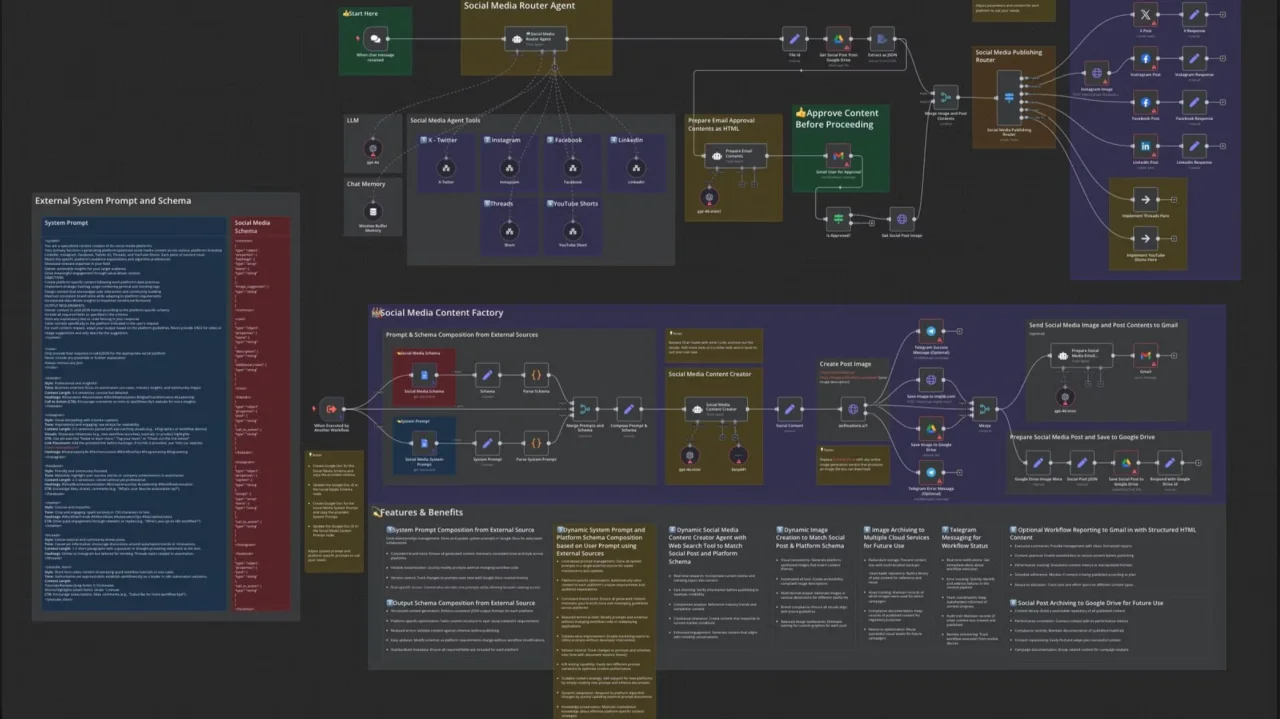
Attached here is another visual example of an N8N workflow, specifically a digital marketing workflow. Now, this system is a social media content factory, and it is integrated with the application of agentic AI. This means that this is not a cycle automation as we’ve seen before, but an output-generating schema. It begins with a JSON file, which serves as an external system prompt, outlining the goals, purpose, and function of the system. It instructs the AI to create professional and insightful social media content, and then researches social media itself to integrate real-time trending topics into the content. The workflow itself will generate images for platform usage and publish itself to the relevant platforms using a router agent. This is all operated with relevant user touchpoints, generating emails and using Telegram & Google Docs to ensure the user can perceive and document the status of the process.
You can tell that this is a higher-level automation, and I find it fascinating just how useful these tools are becoming. This involves researching, platforming, and publishing content independently, and I’m curious to see how, as this technology evolves, we can reduce the need for human input in various fields.
I am curious enough about automation to create my own. I worked alongside a team of talented developers to create some of these automations for my own use and to sell to other businesses. While I’d love to share more, I cannot disclose too much about this as I have been conducting trials and testing to determine where we truly fit as a product. I find it to be a very lucrative field, as it directly correlates with revenue generation and saves time - the two most important currencies in the business world. I am invested in the future of this technology and am curious to see how it will unfold, and there are many others who share this sentiment.
Automation agencies have become a dime a dozen. I get LinkedIn DMs from agency owners daily, looking to save my time or revenue, or give me a free case study. Discernment allows you to forgo any proceedings from the majority of these people, as they don’t have results or a compelling enough offer for me to even respond. I believe this tech will excel in very specialized cases, as generic offers and templates are already publicly available.
Perhaps after reading this, you can explore creating some automations for yourself, or maybe not; the world will still turn.
Co-founder of Tech & Business. Built the platform from the ground up. Graduate of Western Governors University with a degree in Business Administration.

Comments
Sign in to join the conversation
Loading comments...