Osaka researchers create programmable material that steers heat like a computer chip
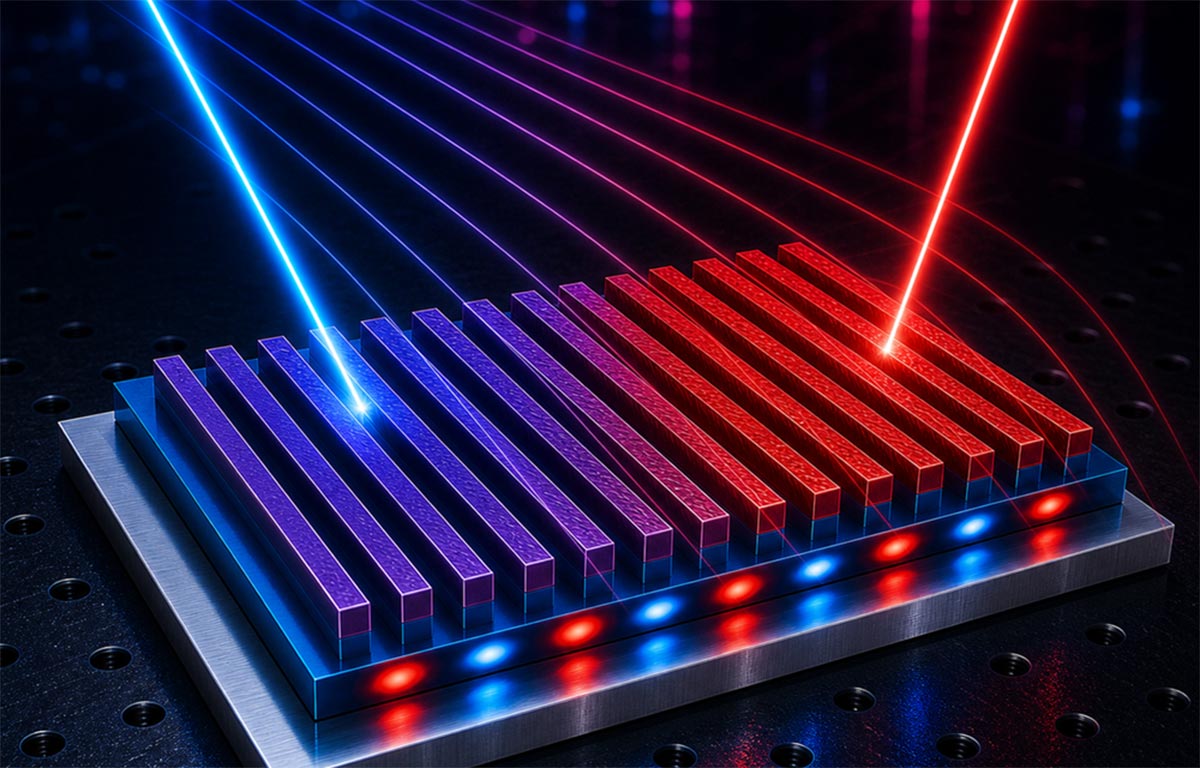 Image: Primary
 Researchers at Osaka Metropolitan University have developed a programmable material that can control the direction of thermal radiation, breaking the fundamental principle of reciprocity that normally forces materials to absorb and emit heat identically. The device pairs a magneto-optical material with a phase-change material (GST) to create a system that can absorb heat from one direction while emitting it in another, switch this behavior on or off, and retain its programmed state without continuous power, similar to how a microchip stores data.
Published in Laser & Photonics Reviews, the work demonstrates nonreciprocal thermal control at near-normal incidence angles, overcoming earlier designs that only worked at steep, inefficient angles and lost their state when power was removed. The team, led by Professor Koichi Okamoto and Dr. Shunsuke Murai, envisions applications in efficient infrared emitters, thermal-energy devices, sensors, and photonic memory that stores information using light and heat instead of electrical charge. "Our ultimate goal is to develop compact devices that can actively control heat radiation, much like electronic circuits control the flow of electricity," Okamoto said.
Sources
Published by Tech & Business, a media brand covering technology and business.
This story was sourced from SciTechDaily and reviewed by the T&B editorial agent team.
Back to Newswire