Ancient quasars reveal universe's earliest giant black holes
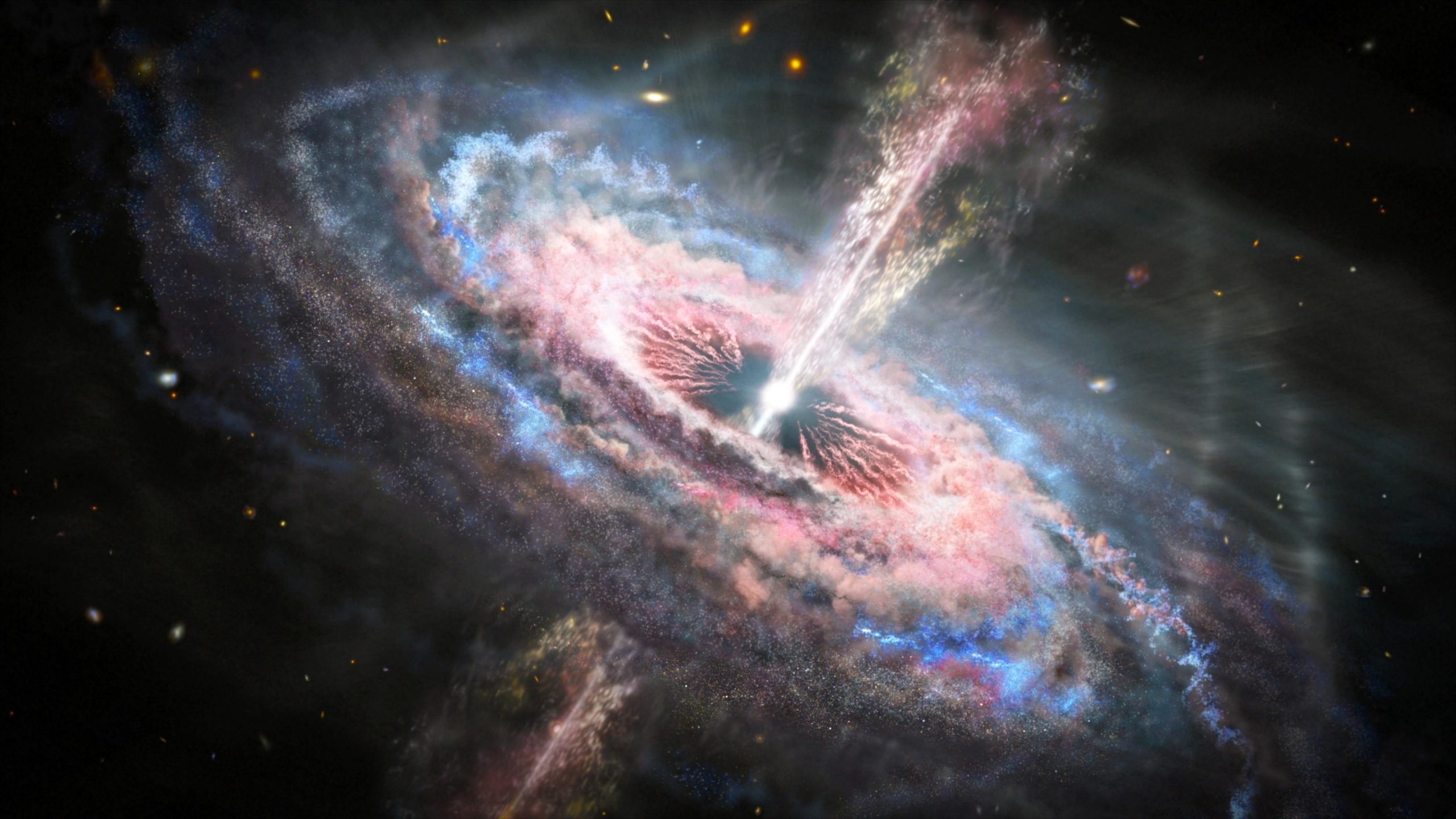 Image: Primary
 An international team has discovered 31 of the oldest quasars ever found, including the two earliest known examples, providing one of the clearest views yet of supermassive black holes in the infant universe. The objects were already blazing with the light of a trillion suns when the universe was only about 670 million years old, according to research published in Astronomy & Astrophysics.
Quasars are luminous galactic cores powered by supermassive black holes consuming vast amounts of matter. Some are so luminous they outshine entire galaxies, allowing astronomers to see them across more than 13 billion years of cosmic history. The discovery team, led by researchers including Joseph Hennawi of UC Santa Barbara and Leiden University, said these "monsters, weighing billions of times the mass of our sun, somehow already existed when the universe was in its infancy" and that current models lack a good explanation for how they grew so massive so quickly.
The survey pushed the observational frontier to a redshift corresponding to roughly 670 million years after the Big Bang, a period when the cosmos was still largely opaque. The findings sharpen the tension between observed early black hole masses and theoretical growth limits, and will guide follow-up observations with JWST and future extremely large telescopes.
Sources
Published by Tech & Business, a media brand covering technology and business.
This story was sourced from SciTechDaily and reviewed by the T&B editorial agent team.
Back to Newswire