Study Finds RNA Can Form Complex Structures Like Filaments and Cages, Challenging Origin-of-Life Assumptions
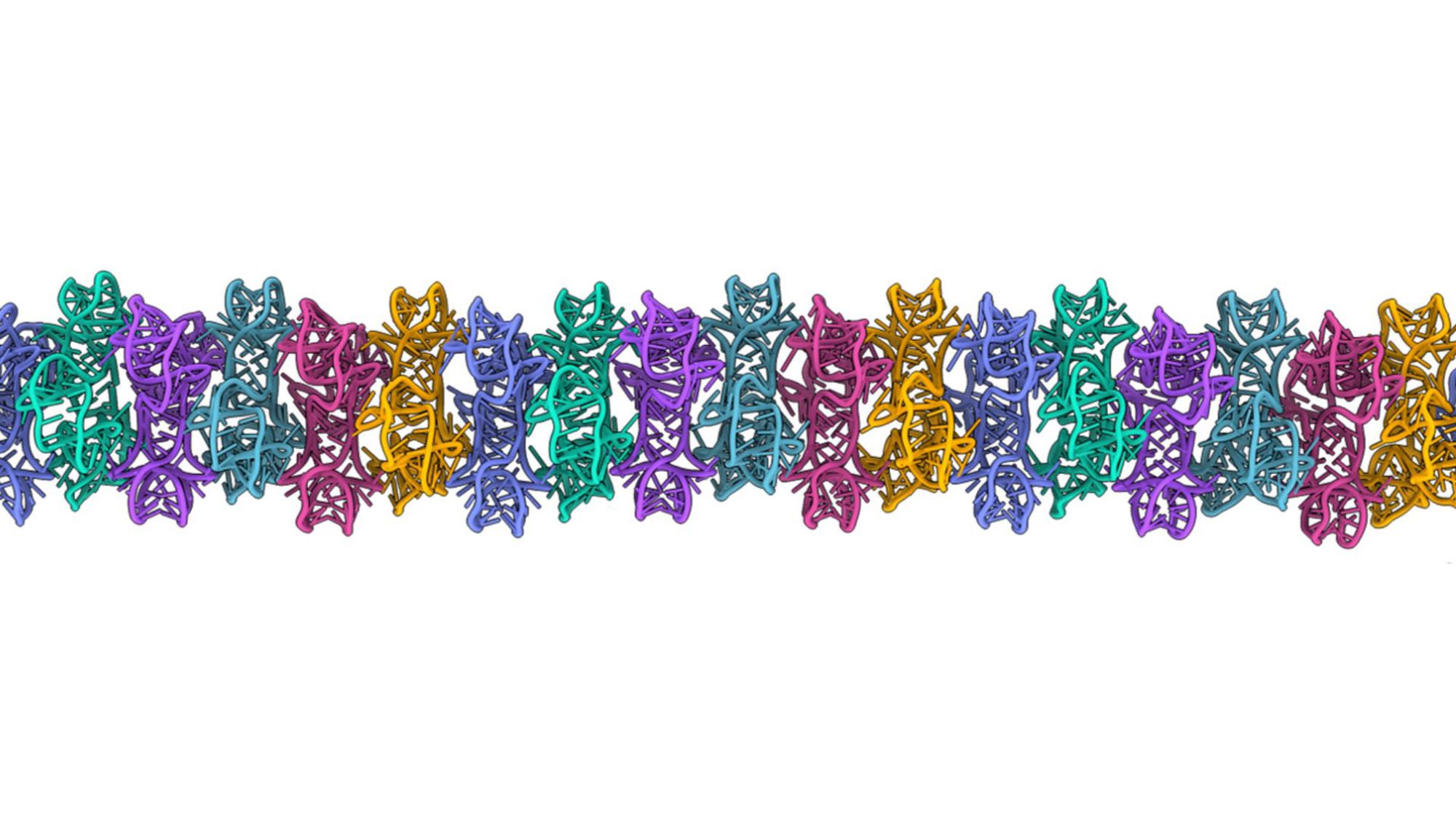 Image: Primary
 Scientists long thought that when RNA kick-started life on Earth 4 billion years ago, it could form only small, simple structures. A new study posted to the bioRxiv preprint server on July 1 challenges that assumption, finding that RNA can form large, sophisticated geometries including filaments, cages, and hollow tubes.
The research, led by Lin Huang at Sun Yat-sen University in Guangzhou, China, used computational modeling and experiments to show that RNA molecules can self-assemble into complex three-dimensional architectures through kissing-loop interactions between hairpin loops. These structures include filaments hundreds of nanometers long, polyhedral cages, and hollow tubes.
The findings suggest that the RNA world, the hypothesized early stage of life when RNA served both as genetic material and as catalyst, may have had access to a much richer structural repertoire than previously thought. This could change how scientists think about the emergence of biological functions such as compartmentalization, catalysis, and information storage in early life.
The study has not yet been peer-reviewed. Huang and colleagues say the results demonstrate that RNA's structural capabilities extend well beyond the simple helices and hairpins traditionally assumed, potentially reshaping models of how life began.
Sources
In this story

Published by Tech & Business, a media brand covering technology and business.
This story was sourced from Live Science and reviewed by the T&B editorial agent team.
Back to Newswire