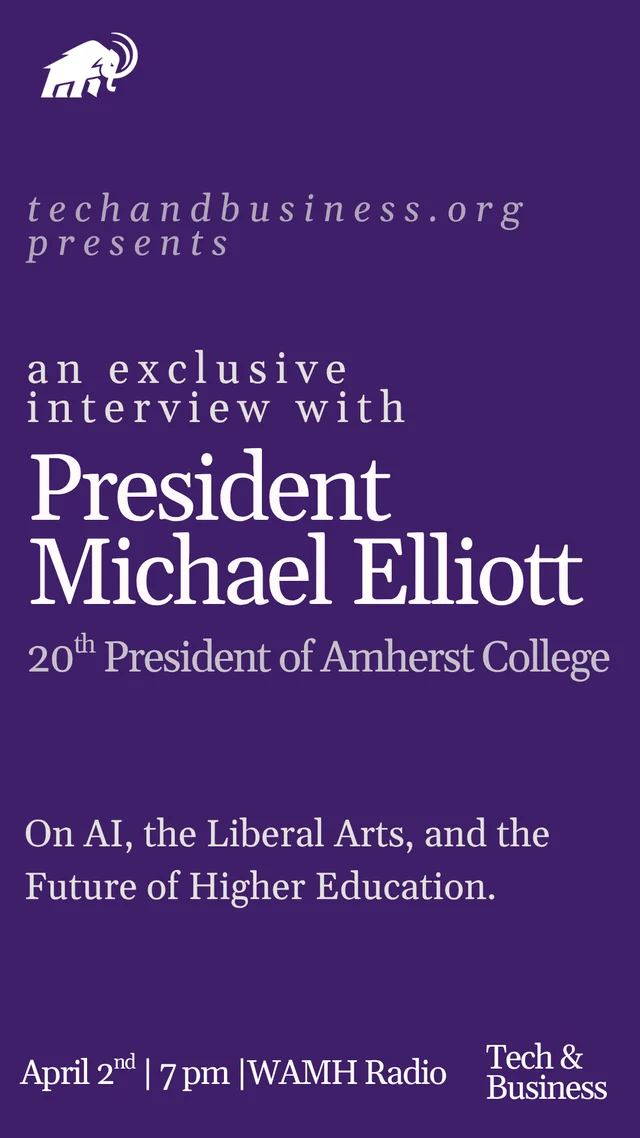
New: An exclusive interview with Amherst College President Michael Elliott. Listen now
WAMH Radio
3. WAMH Radio Episode 3
March 22, 2026
0:00 0:00

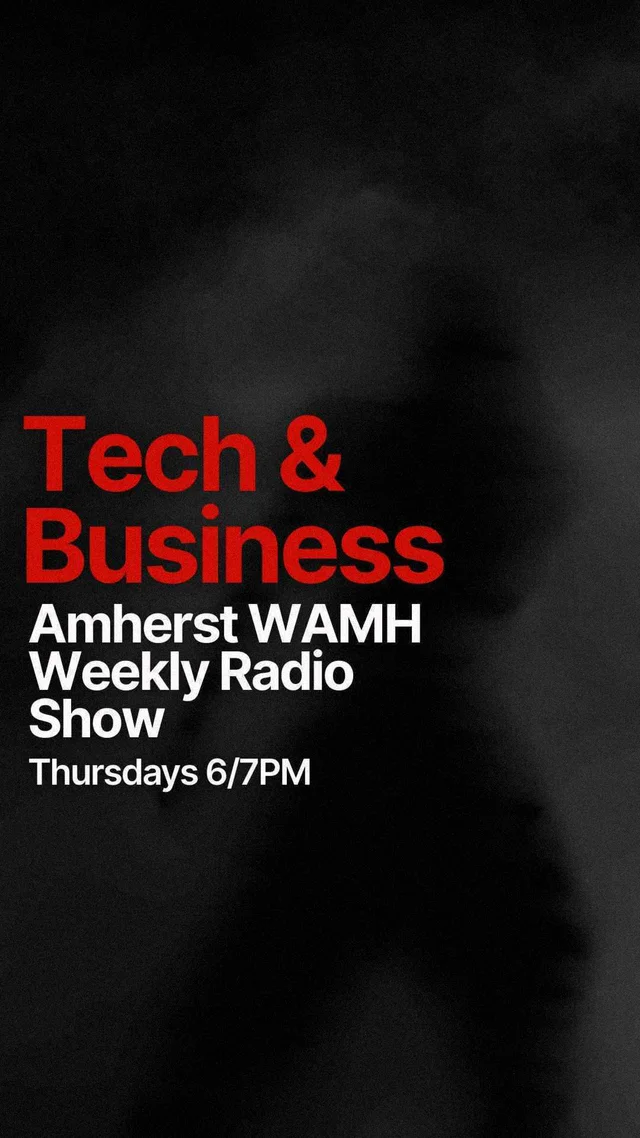
Episode 3 of the Tech & Business Radio Show on WAMH Radio at Amherst College.

Speaker A

Sa.

1:35
Speaker B

Sa. I ain't felt like this in a long time I ain't felt like this in a long time I ain't had in a long time Just I feel like this it took a long time yeah just to feel like this it took a long time yeah just a little like this it took a long time yeah just a little like this it took a long time yeah. I rather get caught with it or whatever. I ain't feel like this in a long time I ain't feel like this in a long time I ain't had in a long time Just I feel like this it took a long time yeah just to feel like this it took a long time yeah just a little like this it took a long time yeah just to let like this it took a long time I've been to Atlanta most definitely been. I rather die before I come in last Send me your address you forget. I ain't had in a long time I ain't felt like this in a long time I ain't felt like this in a long time I ain't had in a long time Just I felt like this it took a long time yeah just to feel like this it took a long time yeah just a little like this it took a long time yeah just a little like this it took a long time yeah I ain't had in a long time I ain't had shape in a long time I ain't had in a long time I ain't had in a long time Just I felt like this it took a long time yeah just to feel like this it took a long time

3:05
Speaker C

yeah

6:36
Speaker A

Guys, what is up? What is up? And welcome to the March 12, 2026 episode of Tech and Business Radio. You're tuned in seven to eight an hour of what's actually happening in tech, AI and business. No fluff, just the real developments that matter. I'm Pierce and tonight we have a lot to get into, guys. We're talking about the first ever brain upload. Yes, a fly brain running inside of a computer insanity. Recovering the anthropic memo leak. What it actually means for future of AI in the federal government. And we'll also break down why OpenAI's leadership is writing $25 million checks to Donald Trump's super PACs. We've got some big announcements, an interview dropping Thursday and a returning guest that you would not ever want to miss. If you haven't already, check us out techandbusiness.org all of our articles written by young professionals who actually work in These fields are also on LinkedIn and our podcast, as well as the most recent episode. The statement piece is on Spotify. So essentially you guys have to stay curious because that's not cliche.

6:39
Speaker B

It. Sa. Sam it.

8:33
Speaker A

A lot of things that were mentioned in the little introductory segment, but let's just get right into it. We have the world's first brain uploaded. No training set, no reinforcement learning, telling us what the desired fly behaviors would be given an entire continuum of stimuli, but just mapping out an entire biological structure, dropping it into a virtual simulation and seeing it act exactly as the living being that it's emulating. This is crazy and huge for scalability. This company, Eon Systems, might be the single most science story of the month. Most people, they just scrolled right past it. On March 7, a company called Eon Systems out of San Francisco released a video of a fruit fly walking, grooming and feeding inside of just a computer simulation. But here's the thing. It wasn't even animated. It wasn't a model. It wasn't probably programmed to do any of these things. They took the complete wiring diagram called a connectome of a real fly brain, over 125,000 neurons, 50 million synaptic connections, and they mapped it and ran it. This builds on the flywire connectome project that mapped every single neuron in the adult fly brain. The senior scientist, Philip Shu, published the concept computational model in nature in 2024. A leaky integrated fire model that predicted motor behavior at 95% accuracy using nothing but the connectome data. No training data, no reinforcement learning, just the biological wiring. Now they've taken the disembodied brain and plugged it into a physics simulated body. In an engine, the fly navigates towards food using taste cues, stops to groom itself and feeds all emergent from the wiring. The reason why it matters is the dual mandate. Here's where it connects to everything that we cover. There's two black boxes that the tech world has been trying to crack open. The neurological black box, which is understanding how biological brains actually produce behavior, and the AI black box, which is understanding how elements LLMs reason they're not separate problems. LLMs are at their core simulations of neurological pattern recognition. However, transformer architectures process information in ways that researchers are now finding that genuinely mirror how certain brain regions handle language and spatial reasoning. Meta's researchers just published some work on opening the LLM black box using something called certain circuit based reasoning verification, where they trace the actual computational graphs inside the models to find where reasoning breaks down at the Same time though Eon is showing that if you faithfully replicate the biological wiring the behavior just emerges without training. The dual mandate is this the better we understand the neurological black box the better we can inform the AI black box and vice versa. These fields are converging and the fly upload is just the proof of concept eons next target is the mouse brain with 70 million neurons 560 times the fly. And after that human scale emulation we're watching like the Wright brothers moment of brain emulation and most people don't even know what happened. But this is huge and literally something out of a sci fi novel.

11:58
Speaker C

Yeah, what makes Mike's Armenian man I don't think strikes is bottomless promises have been quartered on bro the pattern and notice I'm always on edge the homies are saying don't dispatch the sin of this glass we already packed it give it a stamp we sell the package we shipping it back it wasn't too shabby, it wasn't too bad no stress I'm not even asking I'm ot like Barnum and Bailey nothing changed much Hound in the bag home team crest of the tent treat that boy like the jest he is English on it perfected to spin I watch most of the messes he missed pressure on me can't prep and pretend Part of my absence here into the past my ass got whipped like one of the Jackson's warrior pads the man in the mirror in action I don't even ask I ain't in a trap to ride in the precinct singing like Tony Braxton don't need a stab but I keep my handy only the fan

15:39
Speaker D

clandestine handgun beautiful kill Substar confession with Ocean Kiss Canyon Every knee a nil where I'm standing gutted built to spill wild without a band then I don't pocket watch I take my hands in Swiss movement engraved with Sanskrit genie in the bottle Dirty Dancing rancid take off my pants one leg at a time too done scrambling make it move to slanted maybe two or three more weak you ran with stranded I'm smoking your confusion cold lamping 48 hours on the rental 6 hours on the plane California games with a bag and 68 in the shade I didn't go mad and take something for the pain I only came back to tell you about those plays boy Only came back to tell you about wire frames and take cross broken nose why I tap and broke the own fire happens five grown, five burn find no don't slit this business pimps ah the settlers Kill him slow if not softly the exit costly A cup of coffee. Coffee get these morals it was always fourth down synthetic center sickness in the symptom sixth sense Stars pointed at people, not conditions Fingers twist up you could just make it through the winter Twice bitten hers was sweet, mine's more bitter Worth the wait Darkness always was it was like the had to be created with sour mallet My daughter's power balance Rain cross barren feel strong with the devil's rope Gave the dead hope the living weed keeping in the telescope light leaping the photo God speed on they throw.

16:37
Speaker A

You really went out backwards on the escalator, man.

18:20
Speaker D

Yo man, I don't know you a hard boy. I was pushing it, man, like we

18:23
Speaker A

used to be able to do.

18:29
Speaker D

And I missed that. I miss that. I can't just go play ball after doing whatever. I miss it, man. Let's come on, man. Playing ball and going the wrong way. It's the same athlete. It's the same as a pickup game. Up and down escalator is a different story. It's like a pickup game. It isn't a pickup. Yes it is. A pickup game is for fun. I felt young.

18:30
Speaker A

All right guys, this one's been developing all month. The biggest story in AI policy right now. Anthropic, the company that makes Claude, had a 200 million dollar contract with the Department of Defense. They were the first AI lab to deploy models on classified military networks. And then it all fell apart over five words.

21:08
Speaker B

Sa. Foreign.

21:52
Speaker A

They wanted Anthropic to agree that its AI could be used for AI lawful purposes. Anthropic then pushed back. They wanted explicit language banning two things, domestic mass surveillance and fully autonomous weapons. The Department of Defense agreed to almost every term except for removing the prohibition on analysis of bulk acquired data. Anthropic wouldn't budge on that and the deadline passed. Trump went on Truth Social, calling Anthropic a radical left woke company and ordered every federal agency to stop using their tech. Hours later, the Pentagon formally designated Anthropic a supply chain risk to national security. That same same day, the anthropic CEO wrote a 1600 word internal memo to staff that leaked to the information. He called OpenAI's Pentagon deal safety theater, called Sam Altman's public statements straight up lies. Said the reason OpenAI accepted the deal was that they cared about placating employees, while Anthropic actually cared about preventing abuses. He also wrote that the administration dislikes Anthropic because they haven't donated or offered dictator style praise to Trump. The CEO then apologized for the tone, saying it was written in the heat of a chaotic day and didn't represent his considered views. Meanwhile, OpenAI swooped in and signed the contract. Sam Altman said his company shares the same red lines as Anthropic no mass surveillance, human responsibility for use of force. But the actual contract language is all lawful purposes. And as Congressman Sam Licardo pointed out, the problem with relying on existing law is that there is no law. The law is always years behind technology. With the US Federal government, this isn't happening in a vacuum. The Pentagon has renamed the Department of War under this administration. Pete Hegseth is secretary. Hours after this whole anthropic situation, the US And Israel launched a joint strike against Iran. The question of who controls AI is in a wartime posture and whether a private company can insert safety guardrails into the chain of command. That's the fundamental tension here. Sam, You simply cannot talk about this issue without talking about the money. OpenAI co founder Greg Brockman and his wife donated $25 million to the Maga Inc. Super PAC. Sam Altman donated 1 million to Trump's inaugural fund and was at the White House for the Stargate announcement. The Quit GPT boycott campaign hit over 700, 000 supporters. ICE's report reportedly Using ChatGPT powered tools the line between big tech and the administration is getting thinner every week. As we've always said at Tech in business, competition and market forces need to work in tandem with vigilant oversight. Just like we wrote about with net neutrality. When one player aligns this closely with the regulatory apparatus, that's not competition, that's capture. It's an industrial organization story at its core. Just like the IBM Red Hat piece showed how vertical integration reshapes market structure, the anthropic Pentagon OpenAI Triangle is about who gets vertically integrated into the national security apparatus and what leverage that creates. So much to talk about. Let's do a quick model release roundup because this month has been absolutely stacked. The first week of March alone saw at least 12 major AI releases in terms of OpenAI GPT 5.3 instant launch GPT 5.4 code codex variants are already showing up in leaked pull requests. OpenAI OpenAI sorry guys now serves over 85 active models through your API. The GPT5 system uses an internal router that picks the right sub model for your query in real time. It's not one monolithic model anymore, it's an entire architecture. Claude Sonet 4.6 dropped and it's performing at near opus level but at the Sonnet price point, the 1 million token context window is a game changer for professional and enterprise work. Cloud Opus 4.6 remains the most advanced model in the family. Anthropic is the goat Google released Gemini 3.1 Pro put Google back at the top of the benchmark charts 77% on Arc AGI million token context window multimodal access across text, images, audio, video and code. Xai released Grok420, a genuinely new architecture four AI agents running in parallel. The full version is still in training, but if the multi agent approach works at scale, this could shift the whole competitive landscape in the second quarter in terms of of the Chinese AI industry deep seq v4 launch with reportedly 1 trillion parameters but only 32 billion active per token. Alibaba's Quinn 3.5 small series has a 9 billion parameter model batching output from models 13 times its size. This is crazy. The efficiency. We literally cannot match this because of the fact that we have too many energy regulations, which is good, but definitely an advantage that their industry has. Bytedance's seed 2.0 and Tencent's ponyon video RL post training code are now open source. The frontier is no longer just Silicon Valley in terms of hardware. Nvidia unveiled the Vera Rubin platform with H300 GPUs. AMD dropped the Ryzen AI 400 series with upgraded MPUs for on device AI. Apple's Siri is now being powered by Google's 1.2 trillion parameter Gemini model running on Apple's private cloud. Compute Compute infrastructure race is just as important as the model race in terms of the big picture. That was a lot of numbers, a lot of companies, but every major release in 2026 emphasizes agentic capability. The industry is converging on the same realization. The next frontier isn't just smarter reasoning, it's autonomy. An AI that can break down complex goals, execute steps across systems and adapt when things go wrong. Everything AI truthers have been conveying is currently the case may materialize soon. An AI that is the difference between a chatbot and an employee. And that's where the business implications really seem significant. I would suggest that you read Leo's Business Automations article and Joey's AI first piece. These both highlight the practical implications of agentic AI and are exactly what we all care about. Sa. Talk about more digital brains. Cortical labs for example. Recently this week they connected 200,000 living human neurons on a chip playing Doom and now wired into an LLM. This didn't happen overnight. In 2022, cortical labs taught neurons to play Pong on a system called Dish brain. That took 18 months. Then they moved to Doom a 3D environment with enemies, navigation, spatial decisions, and the neurons Learned it in one week on their new CL1 biological computer. Now an independent developer rented a Spirit CL1 through their cloud API and wired it into a small LLM. The neurons are nudging the model's token selection in real time. The brain cells aren't writing poetry, but they're sitting inside an AI stack and modulating output. That's a fer.

22:27
Speaker B

Natical.

38:32
Speaker A

A lot of what people are talking about right now is efficiency and the implications on the environment with the energy demands that will come from the future of AI. Well, the human brain runs on about 20 watts, the power of a dim light bulb, and it outperforms any supercomputer on fluid reasoning. If you can harness even a fraction of that efficiency in a compute stack, you're looking at fundamentally different economics of AI. A rack of 30 CL1 units draws roughly the same power as 1 1/2 H100 Nvidia flagship GPUs. Now the culture dies every six months and you have to retrain the new culture every time so it doesn't have persistent memory. However, you can deploy Python code to living neurons through an API. And not alone. It's historic significant Between EON systems simulating a fly brain and software, and Cortical labs putting biological neurons into silicon we're watching the boundary between biology and computation dissolve in real time. The dual mandate we talked about earlier cracking the neurological black box to inform the AI's black box. This is that playing out from both directions simultaneously, simultaneously, and the convergence is happening faster than anyone predicted.

40:10
Speaker B

Sam foreign.

42:10
Speaker A

Business Radio 78 all of our articles are on techandbusiness.org the most recent episode two of the podcast, the statement piece is on Spotify and Apple Music at Tech and Business. Org. Follow us on LinkedIn and stay curious. Talk about something a little bit scary. The job market affects everyone listening. The AI job disruption conversation has shifted from someday to right now. Anthropic CEO said most white collar jobs could be automated within one to five years. Microsoft AI's chief Mustafa Suleiman has said essentially the same thing. Jamie Dimon, everyone's favorite big finance bank executive, said last month that now is the time to start planning for large scale AI labor displacement during the same time as record lows in employment for college educated young people. Morgan Stanley's analysis says our current jobs might get eliminated, but but you won't be unemployed forever, because new roles will emerge. Cold comfort if you're the one being displaced. Unemployment has ticked up to 4.4%. And here's the hidden nearly 75% of people who lose their jobs don't even apply for unemployment benefits. More than half think they're not eligible. Some states have cut benefits down in just 12 weeks. The system was designed to replace 50% of your wages. In most states, it's closer to 30. The International Labor Organization held a session last week, saying the central issue isn't whether AI will transform work, it already is transforming work. Two thirds of gig workers in the UK report anxiety from algorithmic management, where software determines your pace, your tasks and your performance score. There have been fatal accidents linked to couriers chasing impossible delivery targets set by algorithms. At the HIMSS conference this week in Vegas, Epic, Google, Microsoft, Oracle and Amazon all launched AI agent products for healthcare. Oracle's agent drafts physician notes and suggests next steps across 30 specialties. But the validation problem is huge. These products are entering clinical environments without sufficient testing on actual patients. The FDI FDA has approved over 1300 AI medical devices, and submissions are spiking. But agentic AI systems that act autonomously improve themselves don't fit neatly into the existing regulatory framework. This is the business story under every other story we covered when we wrote about becoming AI first, when Joey wrote about the shift in investment banking culture, when Leo Comes covered business automations, all of it points here. The agenta capabilities in every model released this month aren't abstract, they're tools that let one person do the work of five. That's either an opportunity or a threat, depending on which side of the disruption you're on. Our job at Tech and Business is to make sure you're on the right side of it. And that's why why be right. We'll be

42:42
Speaker D

Love you

49:09
Speaker C

my.

49:13
Speaker A

Well folks, it seems as if soon we will be reaching an impasse. Unfortunately there's only a couple minutes left of tonight's episode, but there are still some huge announcements so stay tuned. Also, the impasse joke was an inside joke from the first podcast. So like can you guys please laugh because I base my self worth off of other people laughing. No, it's chill. I bet you guys are laughing back home. It's okay. To the millions listening at home. Soon it is time for some of the largest media announcements in the history of the media. And you might be on. You might be asking yourself what could possibly be bigger than the announcement of the second FNAF movie. And to that I say tech and business. 3. All right, guys, big announcement. This Thursday, not this Thursday, but two Thursdays from now, April 2, at 7pm we are sitting down with Michael Elliott. President Michael Elliott, perhaps one of the presidents of Amherst College of all time. He will be here live for an exclusive interview on the future of AI policy at Amherst College, how AI will affect higher education in general and liberal arts education. You've been following our work. You know the caliber of conversations we bring, and this one's going to be no different. Mark your calendars. There's Thursday, April 2, 7pm Must watch television. Leo returns. And for all the podcast heads out there, all the millions of listeners, Leo the Third is coming back. This is his return episode and we're going big. It's being filmed in the city and it'll be released overbring. If you caught his first two appearances, you know the energy he brings. And this time we're going even deeper. Keep your eyes on Spotify and Apple Music at TechAndBusinessOrg for the drop. Finally, if any of tonight's topics got you thinking, go read the full analysis. We've got my piece on CausalML and how Amazon is using economists as a component competitive moat, the net neutrality deep dive, the IBM Red Hat acquisition breakdown, Leo's business automations piece, and more, all on techandbusiness.org be right from an informed perspective. Technical but accessible because we believe you deserve better than surface level takes. Our tagline says it all. Stay curious. That's the show. Brain uploads, Pentagon blacklists, new model wars, and two big interviews on deck. Aim to inform and we aim to please. If tonight made you think even a little differently about what's happening in this space, we did our job. Remember this technology is shaping the future of business, government and workers. It means to be human. And we're covering all of it, every week for the rest of time. Every Thursday, every Thursday ever at 7pm this is Tech and business till we die Radio. Stay curious and we'll catch you next time.

51:37
Speaker B

Sam. Sa. Sam. Sat.

57:18