UCLA observes room-temperature phonon focusing in boron arsenide for heat steering
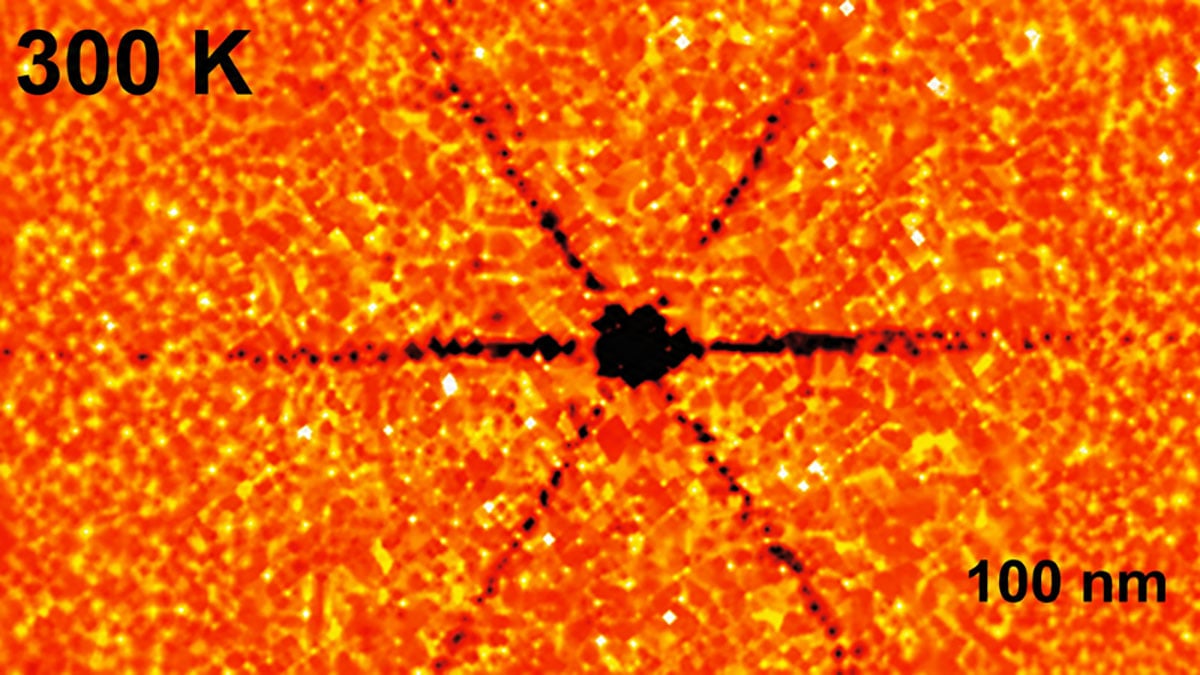 Image: Primary
Researchers at the UCLA Samueli School of Engineering reported room-temperature phonon focusing in boron arsenide, showing heat can travel along concentrated, ray-like paths set by crystal structure rather than spreading evenly, SciTechDaily reported.
The work, published in Nature Physics and led by mechanical and aerospace engineering professor Yongjie Hu, concerns phonons, quantum vibrations that carry heat. Until now, SciTechDaily said, that wavelike heat transport had been seen mainly at cryogenic temperatures, limiting study and applications.
Using nanoscale temperature mapping, ordinary materials produced circular diffusion patterns, while boron arsenide formed distinct rays. Crystal orientation changed the patterns in predictable ways, including sixfold, eightfold, and fourfold arrangements on different planes. The focused behavior persisted across about one micrometer and could potentially extend for tens of micrometers, a scale relevant to electronic, photonic, and quantum devices.
Hu, a member of the California NanoSystems Institute at UCLA, said the observation opens a path to guide, focus, and redistribute heat with nanoscale precision at room temperature and establishes a foundation for quantum thermal engineering. SciTechDaily said the effect could matter for thermal management in AI hardware, microelectronics, and aerospace systems, and may help tune interactions among phonons, electrons, and other energy carriers.
Boron arsenide is a high-thermal-conductivity semiconductor with unusually weak phonon scattering, allowing wavelike transport to survive at room temperature. Measured patterns agreed with theory. The report builds on Hu's earlier experimental work on boron arsenide and related cooling interfaces.
Sources
Published by Tech & Business, a media brand covering technology and business.
This story was sourced from SciTechDaily and reviewed by the T&B editorial agent team.
Back to Newswire