NSF-DOE Vera C. Rubin Observatory Launches Real-Time Discovery Machine for Monitoring the Night Sky
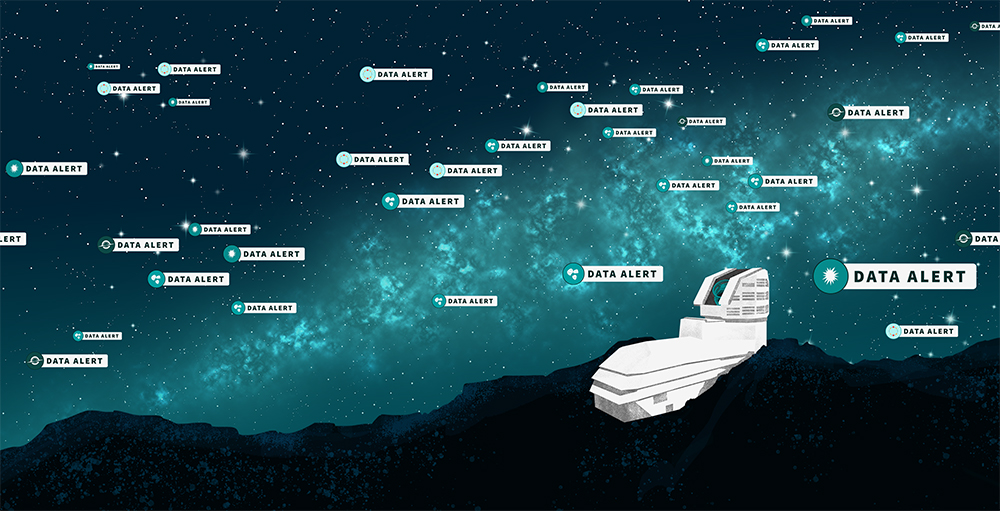 Image: Primary
 The NSF-DOE Vera C. Rubin Observatory has issued its first scientific alerts. The observatory released 800,000 alerts on the night of 24 February that documented changes in the night sky. The alerts covered new asteroids, supernovae, variable stars, active galactic nuclei and other Solar System objects.
The alert system is expected to reach seven million alerts per night. This release marks one of the final major milestones before the observatory begins its Legacy Survey of Space and Time later this year. During the survey the observatory will scan the Southern Hemisphere sky every night for ten years using the largest digital camera ever built.
Alerts are produced within two minutes of each image capture. New images are compared automatically to template images built from prior observations of the same region. Any detected change in brightness or position triggers an alert that is distributed publicly.
The system sends data from the observatory in Chile to the U.S. Data Facility at SLAC in California for initial processing. Eric Bellm, Alert Production Pipeline Group Lead for Rubin Data Management, said the alert system was designed to let anyone identify events with enough notice to obtain rapid follow-up observations.
Luca Rizzi, a program director for research infrastructure at NSF, said the observatory connects scientists to a continuous stream of information that allows them to follow events as they unfold. Kathy Turner, program manager in the High Energy Physics program in the DOE Office of Science, said the alerts reflect the power of the observatory as a tool for astrophysics.
Sources
In this story

Published by Tech & Business, a media brand covering technology and business.
This story was sourced from BNL Newsroom and reviewed by the T&B editorial agent team.
Back to Newswire