Solving a Mystery in Dark Matter Detectors Could Improve Quantum Computers
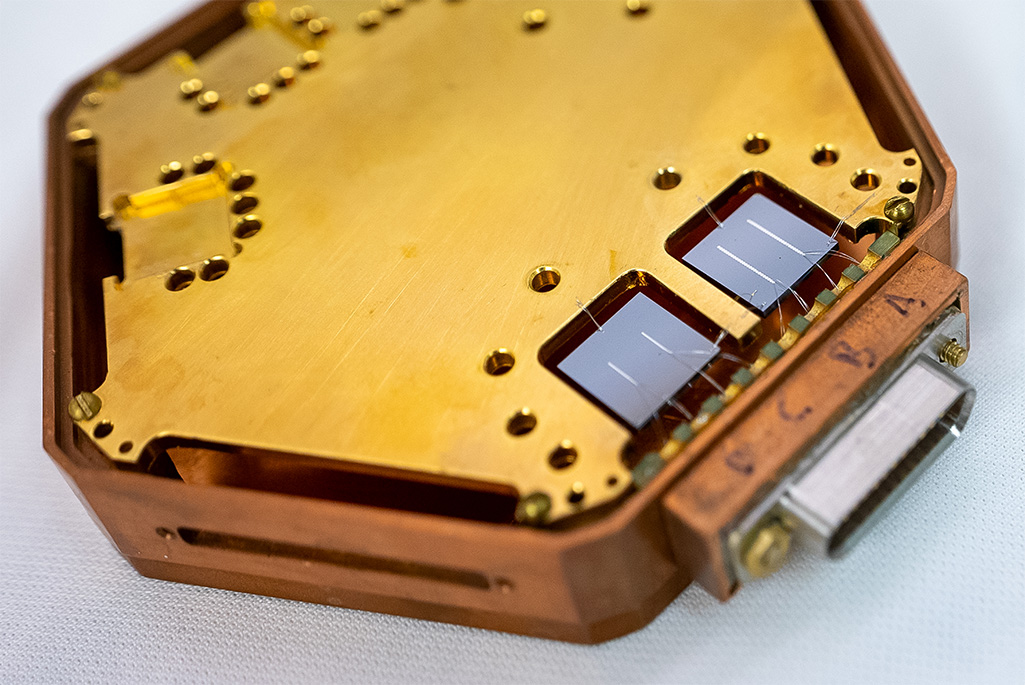 Image: Primary
 Researchers have traced the source of unexpected low-energy events in supersensitive dark matter detectors to the detector material itself. The finding, from the TESSERACT experiment, also indicates a possible cause of errors in superconducting qubits used in quantum computers.
In a study published Dec. 30, 2025, in Applied Physics Letters, TESSERACT researchers reported that the noise, called the low-energy excess or LEE, comes from tiny bursts of vibrational energy within the silicon crystals rather than from electronics or the surrounding environment. The thicker the silicon, the more LEE events occur, they found. TESSERACT collaborators fabricated superconducting phonon sensors on two nearly identical silicon chips that were 1 millimeter and 4 millimeters thick. The thicker chip recorded four times as many events, and the number decreased over time as the detectors cooled.
The bursts can create quasiparticles that disturb a qubit's fragile quantum state and cause it to decohere. Dan McKinsey, director of TESSERACT and a scientist at Lawrence Berkeley National Laboratory, said understanding the issue in particle physics detectors yields information on how to improve quantum computing systems. Matt Pyle, a TESSERACT collaborator and associate professor at UC Berkeley, said the detectors' extreme sensitivity to their environment makes them useful for diagnosing sources of decoherence that limit qubits.
The thinner detector achieved an energy resolution of 258.5 millielectronvolts. That precision allows distinction between events differing by only a few hundredths of an electronvolt. TESSERACT is in the prototype and construction phase and will eventually be installed in France's Modane Underground Laboratory. The collaboration includes researchers at multiple national laboratories and universities.
Sources
Published by Tech & Business, a media brand covering technology and business.
This story was sourced from Berkeley Lab and reviewed by the T&B editorial agent team.
Back to Newswire