Scientists twist tiny crystals to control electricity
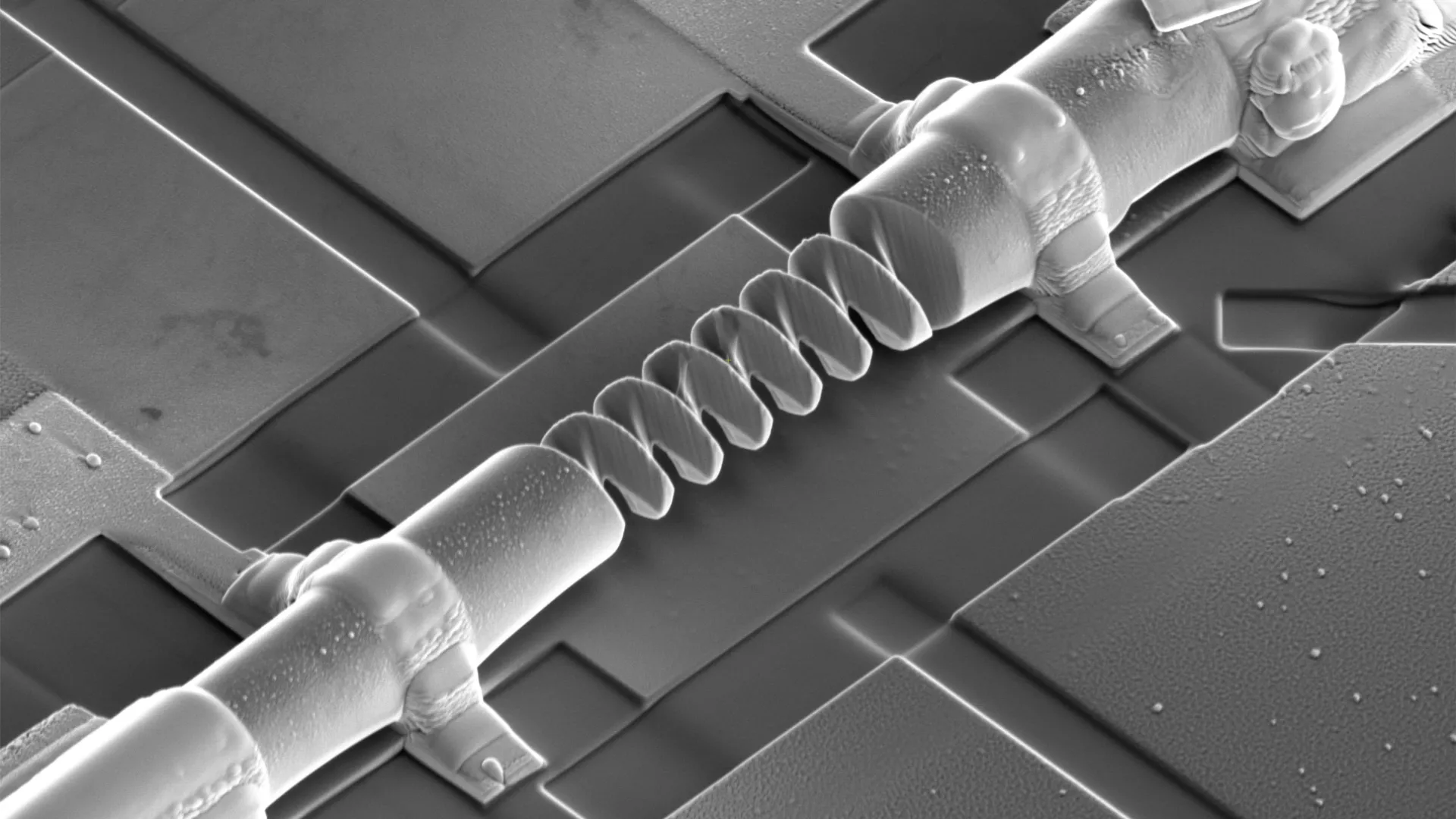 Image: Primary
 Scientists at the RIKEN Center for Emergent Matter Science, along with collaborators, have developed a technique for building three dimensional nanoscale devices directly from single crystal materials. The method uses a focused ion beam instrument that removes material at extremely small scales.
The researchers carved tiny helical structures from a topological magnetic crystal made of cobalt, tin and sulfur. Tests showed that these structures behave like switchable diodes, with electric current traveling more easily in one direction than the other.
The effect can be flipped by changing the magnetization or the twist of the helix. The study, published in Nature Nanotechnology, confirmed the prediction based on the material properties.
By comparing helices of different sizes and measuring behavior at various temperatures, the team traced the diode effect to uneven scattering of electrons along the curved, chiral walls. The findings indicate that the physical shape of a component can directly influence how electricity moves through it.
According to Max Birch, the first author of the study, treating geometry as a source of symmetry breaking on equal footing with intrinsic material properties allows engineering of electrical nonreciprocity at the device level. The focused ion beam nanosculpting method opens a wide range of studies on how three dimensional and curved device geometries can be used to realize new electronic functions.
Yoshinori Tokura, who leads the research group, said the approach enables device designs that combine topological or strongly correlated electronic states with engineered curvature in the ballistic or hydrodynamic transport regime.
Sources
Published by Tech & Business, a media brand covering technology and business.
This story was sourced from ScienceDaily and reviewed by the T&B editorial agent team.
Back to Newswire