Hiroshima-led team identifies Milky Way source LHAASO J1912+1014u as proton PeVatron
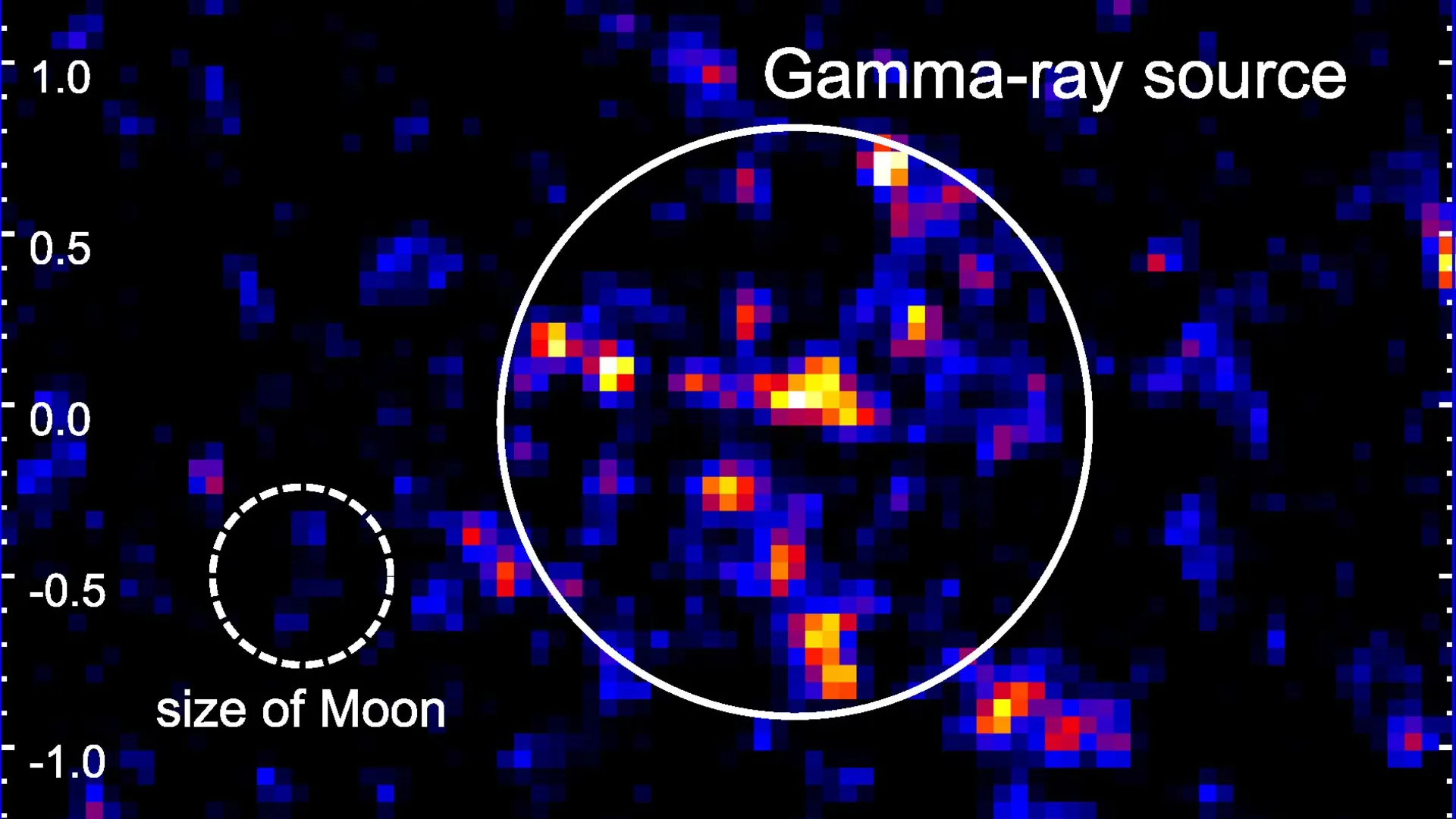 Image: Primary
 An international team led by Hiroshima University reports that Milky Way source LHAASO J1912+1014u accelerates protons beyond one quadrillion electron volts, a PeV threshold, ScienceDaily said, citing results in The Astrophysical Journal.
First author Tsunefumi Mizuno said finding a cosmic-ray proton accelerator above the PeV level is a major goal in modern astrophysics. Cosmic rays are mostly protons; natural accelerators can exceed energies reached by machines such as the Large Hadron Collider.
Earlier Tibet AS gamma and LHAASO detections of high-energy gamma rays could not alone separate proton from electron origins. The team combined Fermi Large Area Telescope GeV gamma-ray data, FUGIN radio maps of interstellar gas, Chandra X-ray observations, and TeV measurements including LHAASO.
ScienceDaily said three findings supported a hadronic, proton-driven scenario: a gamma-ray signal extending smoothly from more than 100 trillion electron volts down to 400 million electron volts; GeV gamma-ray distribution matching interstellar gas; and only very weak diffuse X-ray emission, which would be unexpected for an electron-dominated source. The object lies in Aquila near Altair and was discovered in 2024.
The paper is titled Hadronic Scenario for Galactic PeVatron LHAASO J1912 1014u Supported by Fermi-LAT gamma-Ray Data and FUGIN CO Data and carries DOI: 10.3847/1538-4357/ae680d.
Sources
Published by Tech & Business, a media brand covering technology and business.
This story was sourced from ScienceDaily and reviewed by the T&B editorial agent team.
Back to Newswire


