Silver nanocatalysts switch reaction sites in solid oxide power and hydrogen cells
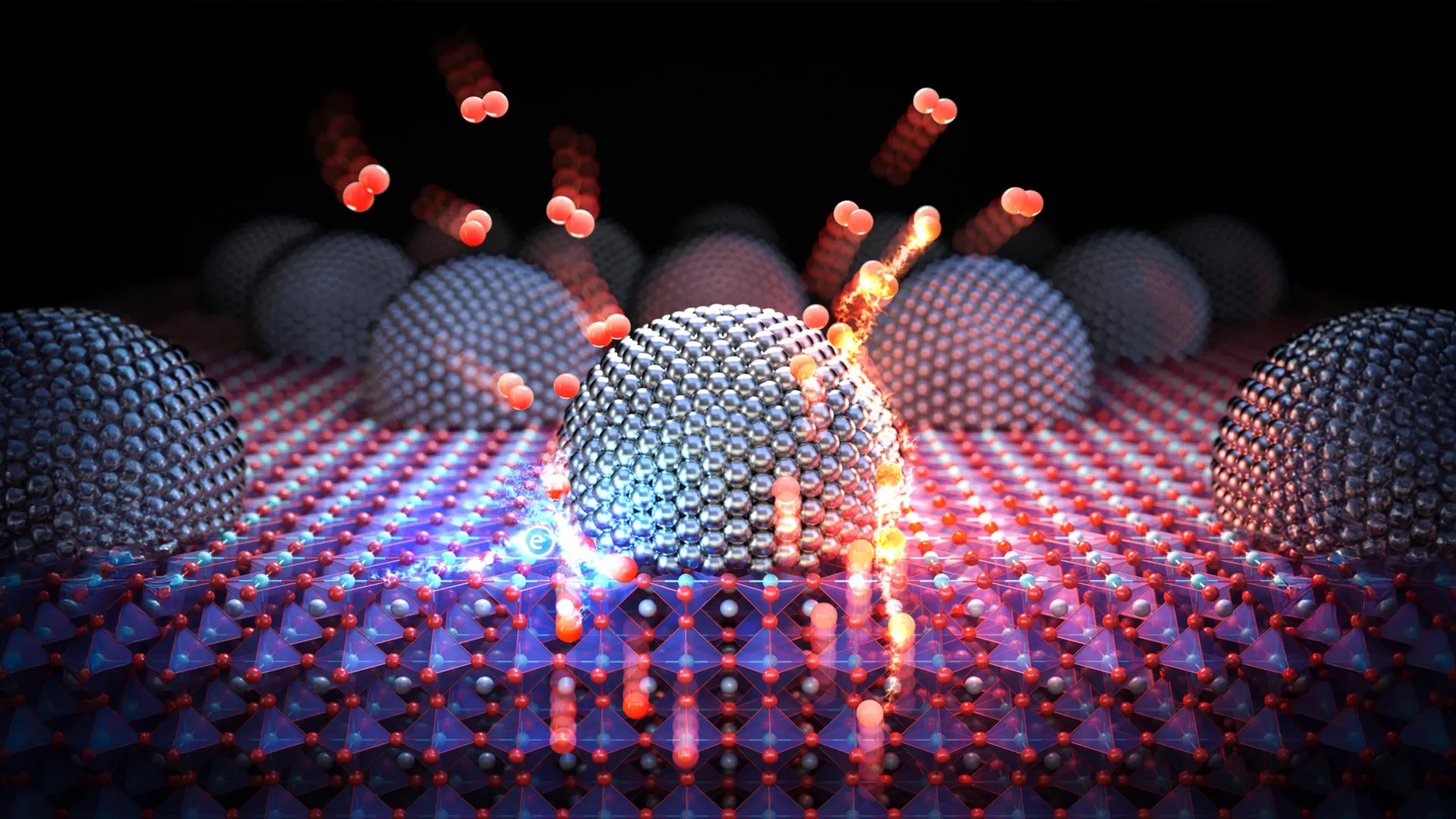 Image: Primary
 Researchers at Seoul National University, working with KAIST and the Korea Basic Science Institute, report that the same silver nanocatalyst can operate at different reaction sites depending on whether a solid oxide cell is producing electricity or generating hydrogen.
Solid oxide cells move oxygen ions through a solid material either to generate electricity or to split water for hydrogen. The technology is viewed as an option for distributed combined heat and power and for renewable-powered green hydrogen. Performance and durability depend heavily on how quickly oxygen reactions occur at the air electrode, but real electrodes have complicated structures that make it hard to pin down where nanocatalysts act.
Earlier work showed metal nanocatalysts can improve cells, yet it remained unclear whether activity sits mainly on the catalyst surface or at the catalyst-electrode boundary, and whether the same mechanism serves both modes. The team built a model electrode with controlled structure and composition, arranging metal nanoparticles of uniform size and spacing in ordered patterns. They compared silver, cobalt, palladium, and platinum deposited on a thin-film perovskite oxide electrode. Silver produced the strongest catalytic improvement among the metals tested.
The researchers then varied silver nanoparticle size and arrangement. During the oxygen reduction reaction used for electricity generation, reaction rates increased as the length of the boundary between silver nanoparticles and the electrode grew, indicating the interface is the main site in that mode. During the oxygen evolution reaction used for hydrogen production, rates increased with silver nanoparticle surface area, indicating the particle surface itself is primary.
Adjusting applied voltage and oxygen concentration, the team found that during oxygen reduction, silver nanocatalysts help transfer electrons to oxygen, while during oxygen evolution they help oxygen atoms combine into molecules and support their release. Synchrotron-based surface analysis combined with atomic-scale theoretical calculations showed silver alters the electrode surface electronic structure in ways that favor reduction and creates conditions that ease oxygen-atom pairing during evolution.
The findings appear in Energy & Environmental Science and were selected as an Outside Back Cover article. The authors say nanocatalysts should not be treated only as generic reaction accelerators, because active locations and mechanisms can change with operating mode. That points to separately engineering catalyst surfaces and catalyst-electrode interfaces for solid oxide fuel cells, electrolysis cells, and reversible cells that both generate power and make hydrogen. Support came from Korea's Ministry of Science and ICT and the National Research Foundation of Korea.
Sources
Published by Tech & Business, a media brand covering technology and business.
This story was sourced from ScienceDaily and reviewed by the T&B editorial agent team.
Back to Newswire