JWST study of Saguaro galaxy suggests little red dots may be distant ordinary galaxies
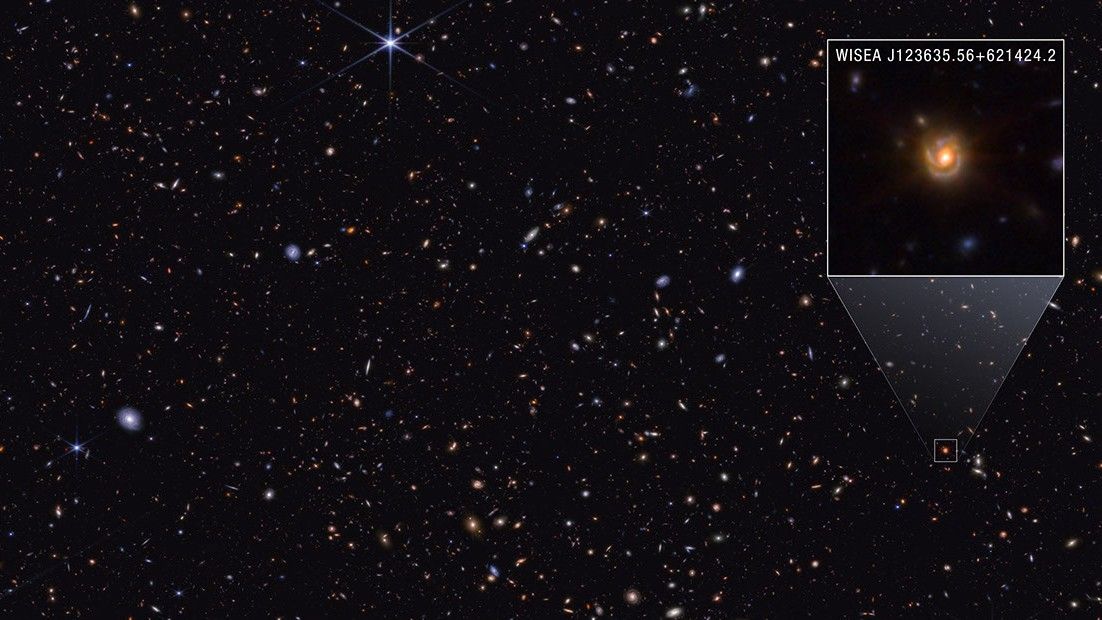 Image: Primary
 A James Webb Space Telescope study summarized by Live Science suggests the early universe's mysterious little red dots may not have vanished, but instead may look different when seen across cosmic time.
Ever since JWST began science operations in 2022, astronomers have found tiny crimson, compact infrared sources that appear in large numbers around 600 million years after the Big Bang and seemingly fade less than a billion years later. Fresh JWST observations combined with Hubble and Chandra data point to a continuity of appearance rather than disappearance.
Researchers pointed JWST at WISEA J123635.56+621424.2, nicknamed the Saguaro, a spiral galaxy near the Big Dipper that existed around 3.3 billion years after the Big Bang. Its compact reddish core matches little-red-dot traits, including unusually weak X-ray emissions, while the galaxy is close enough for spiral arms to remain visible. Computer models shifted the galaxy to early-universe distances until the arms faded and only a tiny glowing red point remained, resembling distant little red dots.
The findings suggest many little red dots may be ordinary galaxies so distant that only bright active centers remain visible, and that the objects may mark a short-lived phase in supermassive black hole growth. Live Science said the hunt continues for more nearby analogs to build a catalog of how galaxies and central black holes evolved together.
Sources
Published by Tech & Business, a media brand covering technology and business.
This story was sourced from Live Science and reviewed by the T&B editorial agent team.
Back to Newswire