Tiny Autonomous Boats Self-Assemble Into Floating Structures at MIT
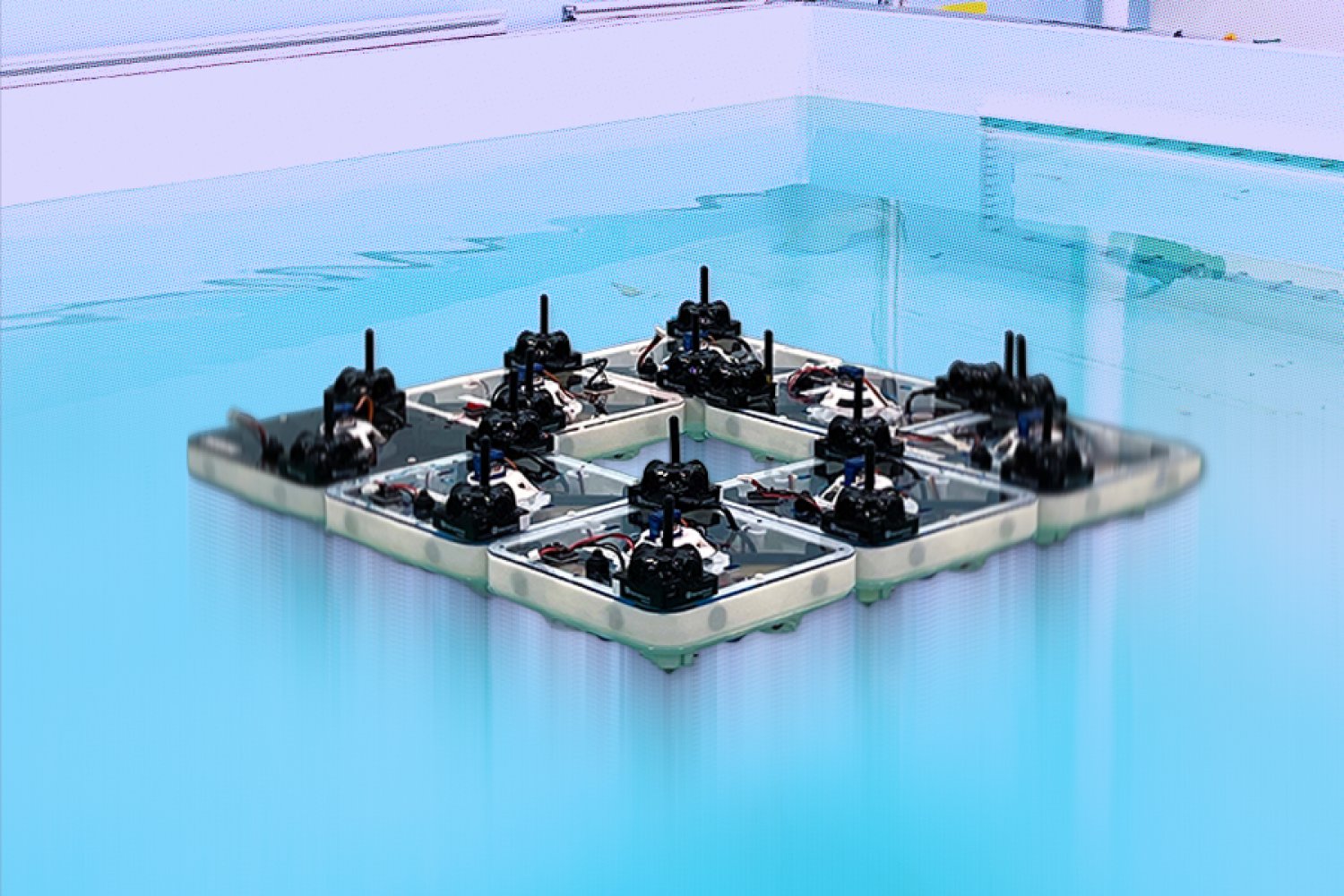 Image: Primary
 MIT researchers have demonstrated a fleet of miniature robotic boats that can autonomously connect to form floating platforms, bridges, and other structures on demand. The system, called Roboat II, builds on years of work from MIT's Computer Science and Artificial Intelligence Laboratory (CSAIL) and the Senseable City Lab.
Each boat is a 3D-printed hull about 4 feet long, equipped with four thrusters, GPS, inertial sensors, and a latching mechanism on its bow and stern. The vessels communicate over Wi-Fi and use onboard algorithms to coordinate their positions, docking with centimeter-level precision to form rigid, load-bearing connections.
In pool tests, the boats assembled themselves into a 6-by-6-foot platform capable of supporting a person, a floating bridge spanning a 10-foot gap, and a curved breakwater that reduced wave energy by 40 percent. The structures held their shape under wind and current disturbances, with the fleet continuously adjusting thruster output to maintain tension across the latches.
"We're moving from thinking of boats as vehicles that transport things to thinking of them as pixels that can form infrastructure," said Carlo Ratti, director of the Senseable City Lab and professor of the practice in MIT's Department of Urban Studies and Planning. "In a city like Amsterdam or Venice, where water is the street, you could deploy pop-up bridges, event stages, or flood barriers in minutes."
The control system uses a distributed algorithm: each boat maintains a local map of its neighbors and computes its own thrust commands without a central coordinator. If one boat fails or is removed, the rest redistribute forces to keep the structure stable.
The team envisions applications in flood response, temporary event infrastructure, and environmental monitoring. The next phase will test saltwater durability, longer-duration deployments, and integration with shore-based power and data networks.
Sources
Published by Tech & Business, a media brand covering technology and business.
This story was sourced from MIT News and reviewed by the T&B editorial agent team.
Back to Newswire